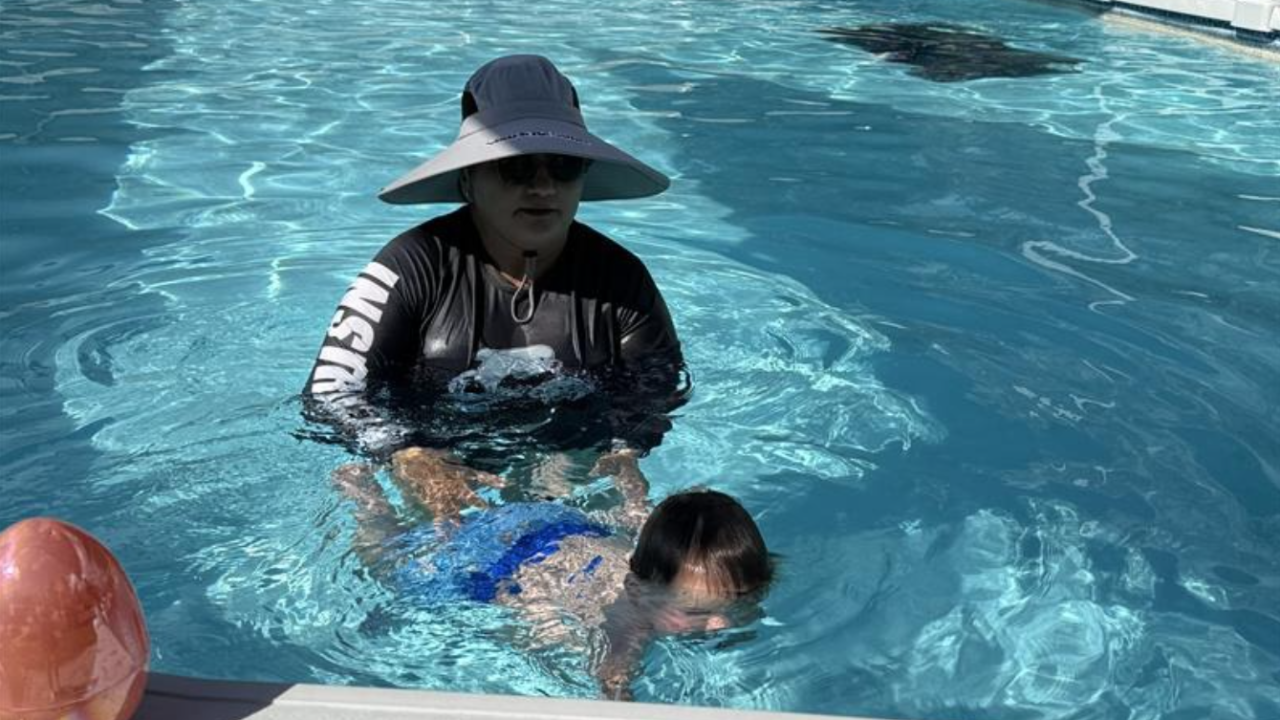
Florida is expanding a state program that helps families pay for children’s swimming lessons as officials confront a troubling rise in childhood drowning deaths.
Gov. Ron DeSantis signed legislation earlier this year expanding eligibility for Florida’s swimming lesson voucher program from children age 4 and younger to children ages 1 through 7. The program was created in 2024 as part of a broader effort to reduce preventable drowning deaths among young children.
The expansion comes as Florida continues to record a high number of child drownings. The state recorded 120 child drowning deaths last year, the highest number on record, according to the Department of Children and Families. Through the date reported by WUSF, 89 children had died from drowning this year, putting Florida on pace to exceed last year’s total.
Drowning is the leading cause of accidental death for Florida children between ages 1 and 4. State lawmakers have increasingly focused on swimming instruction and parental awareness as practical tools for preventing these tragedies.
Under the expanded program, eligible families can receive vouchers to help cover the cost of swimming lessons. The program also includes provisions aimed at increasing parents’ awareness of drowning risks and prevention.
The need is clear, but the program’s early numbers also raise questions about how efficiently state assistance is reaching families.
During the current fiscal year, the Florida Department of Health received 16,663 applications for swimming lesson vouchers. The department awarded vouchers to 4,945 applicants, meaning fewer than one-third of applications resulted in an award.
Expanding eligibility could allow more children to receive instruction, but it also increases demand for a program that has already struggled to accommodate all applicants. That makes implementation just as important as the expansion itself.
Supporters argue that providing swimming lessons is a relatively straightforward investment in prevention. Children who learn basic water safety and swimming skills may be better equipped to respond if they unexpectedly enter a pool, lake or other body of water.
The legislation also recognizes that swimming ability is only one part of the problem. Young children can drown quickly and often without attracting attention, making active supervision, barriers around pools and awareness of water hazards important parts of prevention.
Children with autism face particular risks. Research previously cited by Florida officials and researchers has found that children with autism are disproportionately represented among drowning victims, with wandering or leaving a supervised area identified as an important risk factor.
Florida’s approach places much of the emphasis on giving parents and children practical tools rather than relying solely on government intervention after an accident occurs.
That distinction matters. Swimming lessons cannot replace responsible supervision, secure pool barriers, or parental vigilance. No voucher program can eliminate the risks associated with Florida’s abundant pools, waterways and beaches.
The state can provide assistance, but families remain the first line of defense.
The expansion nevertheless represents a significant change in the state’s strategy. Children up to age 7 can now qualify for assistance, giving more families an opportunity to introduce formal swimming instruction at an earlier age.
Whether the expanded program will reduce Florida’s drowning rate remains to be seen. For now, the state’s record number of child drowning deaths provides a compelling reason to examine what works, ensure taxpayer-funded assistance reaches as many eligible families as possible, and keep the focus on basic water safety rather than treating drowning prevention as simply another government program.
Florida has expanded the tool. The next test is whether it can deliver results.
Follow the St. Pete-Clearwater Sun on Facebook, Google, & X
St. Pete-Clearwater Sun: local St. Pete-Clearwater & Tampa Bay, FL news at PIE-Sun.com


Leave a Reply