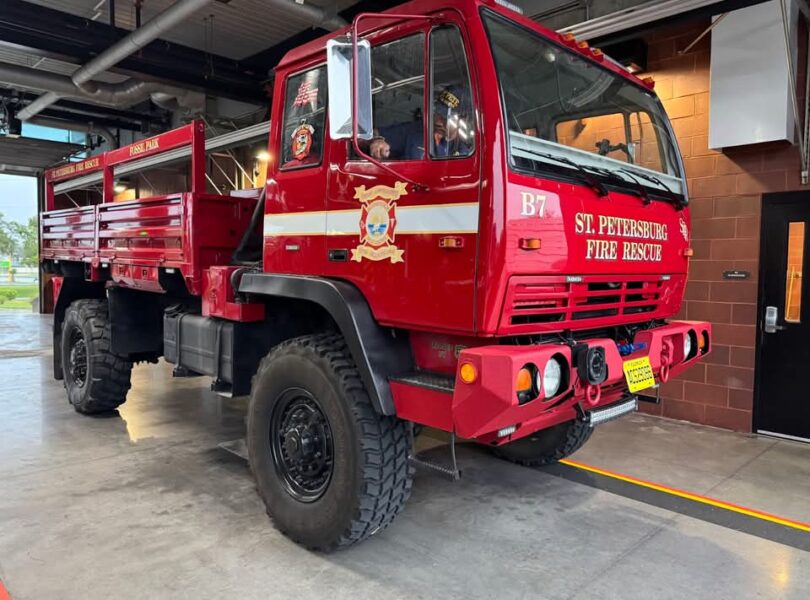
St. Petersburg Fire Rescue (SPFR) has relied on a single high-water vehicle for countless citywide missions during recent storms. Soon, that number will jump to four.
City Councilmember Lisset Hanewicz brought attention to this critical update during Thursday’s meeting, pulling it from the often-ignored consent agenda. Her visit to Station No. 4—serving Shore Acres, the city’s lowest-lying area—after Hurricane Helene revealed the urgent need. When she asked SPFR staff how the city could assist, their answer was clear: more high-water rescue vehicles. Division Chief Brett Ciskoski explained that during Helene, the department had to borrow inadequate trucks to extract residents from floodwaters.
“These vehicles will save lives,” Ciskoski emphasized. “That’s what matters most.”
Hanewicz and the council fast-tracked the request, though officials initially thought only one additional vehicle was feasible. Then, St. Petersburg’s Fleet and Procurement Departments secured a deal with Memphis Equipment Company for three remanufactured military vehicles at $280,500. These trucks can handle water depths of 30 to 42 inches.
SPFR’s current high-water vehicle, based near Fossil Park, has served for over a decade. “It’s old and needs constant repairs,” Ciskoski said. “These new ones will be a game-changer.”
Memphis Equipment will outfit and deliver the refurbished trucks, two of which will include pumps for firefighting. Ciskoski noted that floodwaters often block fire engines from reaching blazes, though the city’s pressurized hydrants—operable even when submerged—have been a saving grace, according to firefighter-paramedic Noah Torres.
The new vehicles feature side lift gates to load stretchers and wheelchairs, a capability absent in the borrowed trucks used previously. Flood risks, once confined to eastern neighborhoods like Shore Acres and Riviera Bay, now threaten areas from west St. Petersburg to Lake Maggiore in the south, driven by unpredictable storms.
With four vehicles, SPFR can now position them strategically across the city. The need is undeniable: in 2017, Hurricane Irma prompted four non-emergency evacuations, while in 2023, Hurricane Idalia saw 75 people and 18 pets rescued in just three hours. Flash flooding in September 2024 trapped five vehicles one day and 50 the next.
“We were racing around with our one vehicle, trying to ensure no one was stranded,” Ciskoski recalled. “I was wading through waist-deep water on 34th Street.”
During Helene, SPFR borrowed three trucks, evacuated 430 residents, handled 1,744 emergency calls, and tackled seven structure fires. All four vehicles lacked lift gates, forcing rescuers to improvise with ladders. Torres, part of the High-Water Rescue Team, downplayed the heroics: “We had a job to do—families were everywhere.”
Councilmember Brandi Gabbard reflected on a Riviera Bay senior who perished during Helene. While the new fleet might not have saved him, she’s confident it will prevent future losses. “Is this enough?” she asked. “As flooding worsens with growth, will it suffice?”
Ciskoski assured her SPFR would flag further needs. Gabbard urged him to keep the council informed. Councilmember Corey Givens Jr. praised the move as progress toward equitable emergency response. “Thank you for being our first responders,” he said.
Follow the St. Pete-Clearwater Sun on Facebook, Instagram, Threads, Google, & X
(Image credit: City of St. Pete)
PIE-Sun.com: local St. Pete-Clearwater news
Leave a Reply