
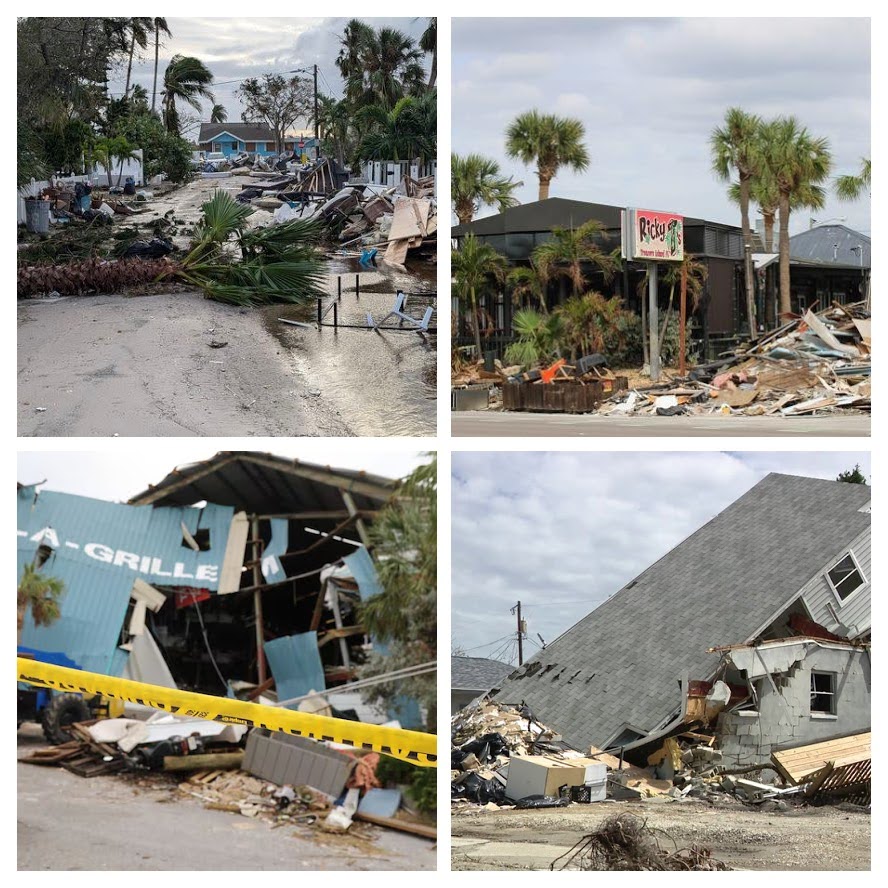
Nearly six months after Hurricane Milton tore through the Tampa Bay area, the National Hurricane Center (NHC) has officially classified it as one of the most intense Atlantic hurricanes on record.
According to the NHC’s final storm report released Monday, Milton’s central pressure dropped as low as 895 mb, while its winds peaked at 178 mph. This ties Milton with Hurricane Rita (2005) for the fourth-lowest minimum central pressure recorded in an Atlantic hurricane. However, because Milton reached peak intensity between Hurricane Hunter aircraft missions, the NHC acknowledged some uncertainty in its estimates.
Milton, which initially intensified into a catastrophic Category 5 hurricane, weakened but remained a major storm as it neared Florida’s Gulf Coast. The NHC noted that its exact intensity at landfall remains uncertain. The storm came ashore on Siesta Key with estimated maximum sustained winds of 115 mph, classifying it as a Category 3 hurricane.
Across Florida, the highest sustained winds recorded reached 90 mph, with a peak gust of 107 mph measured at a University of Florida research tower in Venice Beach—south of where the NHC estimated the storm’s strongest winds made landfall.
“If these major hurricane winds impacted the coastline, they were likely limited to a small area near Sarasota and Siesta Key,” the NHC reported.
Assessing Milton’s storm surge proved challenging due to lingering damage from Hurricane Helene, which had struck just two weeks earlier. Observations indicate storm surge inundation of 6 to 9 feet from Venice to Boca Grande, with water levels peaking at 10 feet on Manasota Key, not including wave crests.
While storm surge flooded areas south of the landfall site, communities to the north faced extreme rainfall and freshwater flooding. The highest recorded rainfall total exceeded 20 inches near St. Petersburg.
Milton also triggered a significant tornado outbreak across southeast and southwest Florida. The storm produced 45 tornadoes, including a tornadic waterspout over Lake Okeechobee. Among them were three EF-3 tornadoes, six EF-2s, 25 EF-1s, seven EF-0s, and four of undetermined intensity. Fourteen people were injured.
According to the NHC, this was an unusually severe tornado outbreak for a tropical cyclone. Milton became the first storm to generate multiple EF-3 tornadoes since the Storm Prediction Center began tracking tropical system-related tornadoes in 1995.
The storm is directly blamed for 15 fatalities, including six people killed by an EF-3 tornado near Fort Pierce and Vero Beach. Four others died from falling trees, and two from freshwater flooding. Additionally, Milton caused 27 indirect deaths in Florida.
Follow the St. Pete-Clearwater Sun on Facebook, Instagram, Threads, Google, & X
(Image credit: WFLA/Tampa Bay Times/WTSP)
PIE-Sun.com: local St. Pete-Clearwater news



 St. Pete-Clearwater Sun
Leave a comment