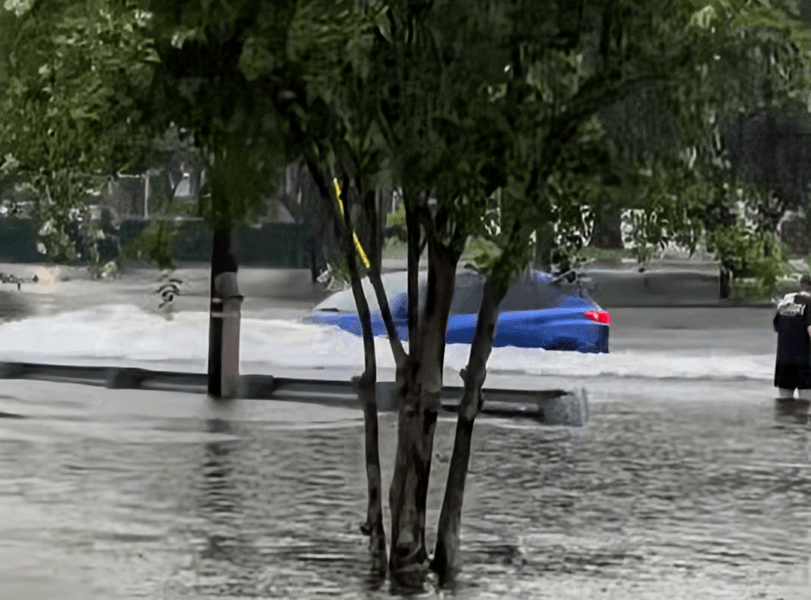
St. Petersburg officials and local legislators have teamed up to reduce the number of vehicles that push floodwaters into otherwise dry homes.
A new bill, crafted locally, seeks to bypass state preemption and allow local governments to regulate vehicle speeds on flooded roads. The proposed legislation would also enable law enforcement to cite drivers who create wakes—small waves—of stormwater.
City council members and administrators discussed the initiative at a Jan. 16 committee meeting. Amber Boulding, the emergency management director, noted that flooding is now a citywide problem that occurs even without a named storm.
“We hear the cry from residents,” Boulding said. “It’s not only the water getting pushed into their house. It’s their ruined yards from people who can’t see where the road is, or they’re cutting curbs to keep from staying in the deep part.”
Boulding, who lives in a flood-prone neighborhood, said she knows the feeling of “sitting on pins and needles” as water overtakes a driveway and encroaches on a home. She described watching water recede, only for a passing vehicle to cause it to inundate a garage, as “the worst feeling ever.”
Boulding noted that cars traveling through flooded streets often stall and impede first responders. However, state preemption prevents local governments from enforcing lower speed limits.
Councilmember Brandi Gabbard, Rep. Lindsay Cross, and Sen. Nick DiCeglie have worked with city officials, including Boulding and Assistant Police Chief Mike Kovacsev, to craft a bill that negates the state’s oversight. “We have brought forward some language to our delegation, and there is a bill that has come out of drafting,” Gabbard said.
She recently met with DiCeglie, who said lawmakers could include the legislation in a “very large hurricane package.” That would increase its odds of passing through the Legislature, which convenes on March 4. Gabbard said DiCeglie “would like our support in a resolution, regardless of the path it takes.”
The first step is passing the resolution at Thursday’s city council meeting. Gabbard said local legislators also requested support letters from individual city departments.
Kovacsev said the St. Petersburg Police Department regularly receives complaints from residents regarding vehicles causing wakes on inundated roads. “It’s traumatizing for them that they flooded once, but then people are driving through streets excessively fast and pushing water back into their houses.”
Kovacsev noted that officers prohibited traffic in flooded areas during Hurricanes Helene and Milton. “You can’t do that throughout the city,” he said.
While citing people for speeding is not a departmental priority during a storm, Kovacsev said the ability to do so when needed and the corresponding educational aspect is a “huge component.” Chief Anthony Holloway and Pinellas County Sheriff Bob Gualtieri support the initiative.
The resolution states that local governments in flood-prone areas of Louisiana and South Carolina have outlawed any motor vehicle or watercraft from traveling faster than 5 mph on flooded streets “or in such a manner as to cause water, waves, or wakes to damage property.” The proposed legislation would follow suit.
City officials believe the bill would help protect first responders and reduce accident risks on damaged roads. The resolution also notes that floodwaters can hide debris and other obstructions.
Lawmakers could amend the bill during the committee process. However, Gabbard said she has not heard any opposition to the legislation, and stakeholders are working to establish a statewide public safety coalition to support its approval.
“This alone isn’t going to solve the issue,” Boulding said. “But it’s going to bring awareness to it.”
Follow the St. Pete-Clearwater Sun on Facebook, Instagram, Threads, Google, & X
(Image credit: St. Pete Police Department)

 St. Pete-Clearwater Sun
Leave a comment