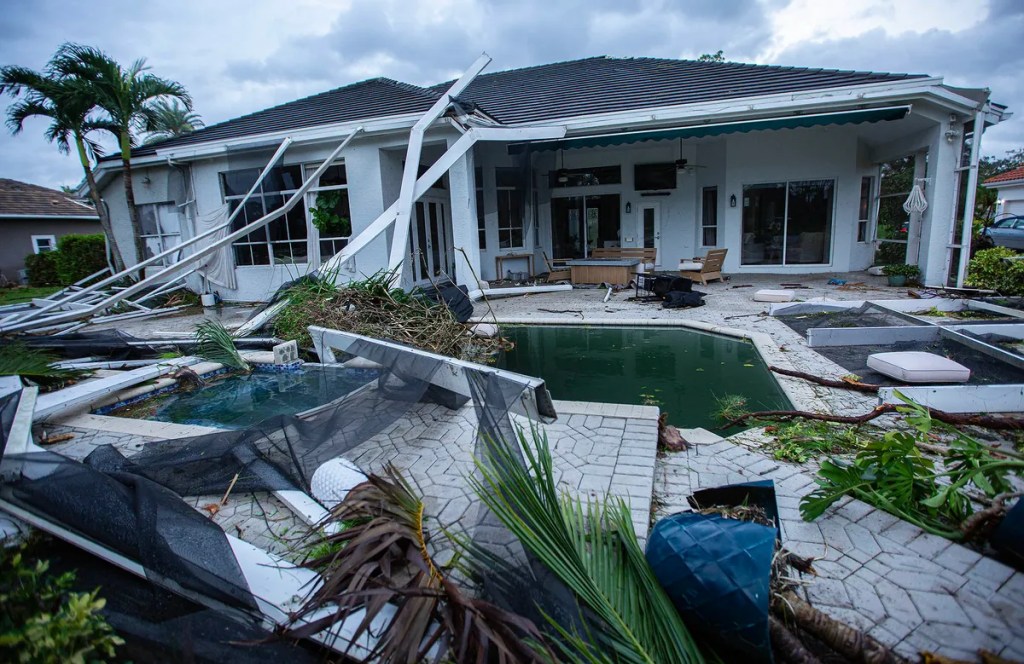
Local leaders are eagerly awaiting the rollout of a new state program aimed at helping residents whose homes were left uninhabitable after Hurricanes Helene and Milton.
In St. Petersburg alone, approximately 16,000 homes sustained damage from the back-to-back storms, leaving the city in dire need of external support. During a committee meeting on Nov. 21, City Council members discussed the forthcoming initiative with Angie O’Dell, Mitigation Planning Manager for the Florida Division of Emergency Management (FDEM).
O’Dell introduced the residential hazard mitigation grant program, emphasizing the state’s efforts to streamline the process for residents.
RELATED: State of Florida Aids Beach Cities Struggling with Hurricane-Related Permit Backlogs
“We’re cutting out the bureaucracy of having residents go through local governments to administer grants,” O’Dell explained. “The state is taking on that responsibility for municipalities and counties.”
In addition to simplifying the grant process, the state will handle the administrative work required to secure federal reimbursements.
FEMA funds recovery efforts after federally declared disasters, with FDEM managing the Hazard Mitigation Grant Program. The program allows city and county governments to repair infrastructure, enhance stormwater systems, and purchase disaster recovery equipment like generators. Importantly, the program also provides resources for residents to rebuild their homes.
Councilmember Brandi Gabbard underscored the need for such assistance, highlighting the burden on city staff and thousands of affected residents.
Although FDEM has a framework in place, O’Dell noted that the program’s launch timeline remains uncertain.
“We don’t yet have vendors secured for the application process,” she said. “But we need to submit applications to FEMA by March, so we’re working to expedite this as much as possible.”
The state’s plan includes assigning project managers to guide residents through the application process, respond to information requests, and compile required FEMA documentation. Case managers will assist with contractor issues and provide updates on construction progress.
Eligible homeowners can use grant funds to elevate, rebuild, or demolish and reconstruct their homes. However, Gabbard highlighted challenges, including a shortage of contractors and the specialized skills required for property elevation.
O’Dell assured council members that FDEM would issue a statewide request for vendors and seek out specialty contractors, even from outside Florida. Approved applicants will receive a list of vetted companies to streamline the rebuilding process.
RELATED: As FEMA Extends Application Deadline, It Approves Millions in Additional Aid for Tampa Bay Area
“This is critical because, historically, securing a contractor has always been a major hurdle,” Gabbard noted.
The program’s ambitious goal is to compress the timeline for rebuilding projects, completing in 12 to 18 months what typically takes three to four years.
Councilmember Lisset Hanewicz expressed concern about the volume of applications and asked how many residents the program could assist. O’Dell was unable to provide an estimate but encouraged local governments to compile lists of interested homeowners.
Residents can sign up for updates through FDEM’s online portal and will soon receive detailed guidance on how to expedite their applications.
“This is still largely a word-of-mouth initiative,” O’Dell said. “We haven’t officially notified counties and municipalities about the state-run program.”
To stay informed and receive FDEM updates, visit https://www.floridadisaster.org/subscription-topics.
Follow us on Facebook, Instagram, Threads, Google, & X
(Image credit: The Palm Beach Post)

 St. Pete-Clearwater Sun
Leave a reply to Pinellas County Accused of Undervaluing Hurricane-Damaged Properties – St. Pete-Clearwater Sun Cancel reply