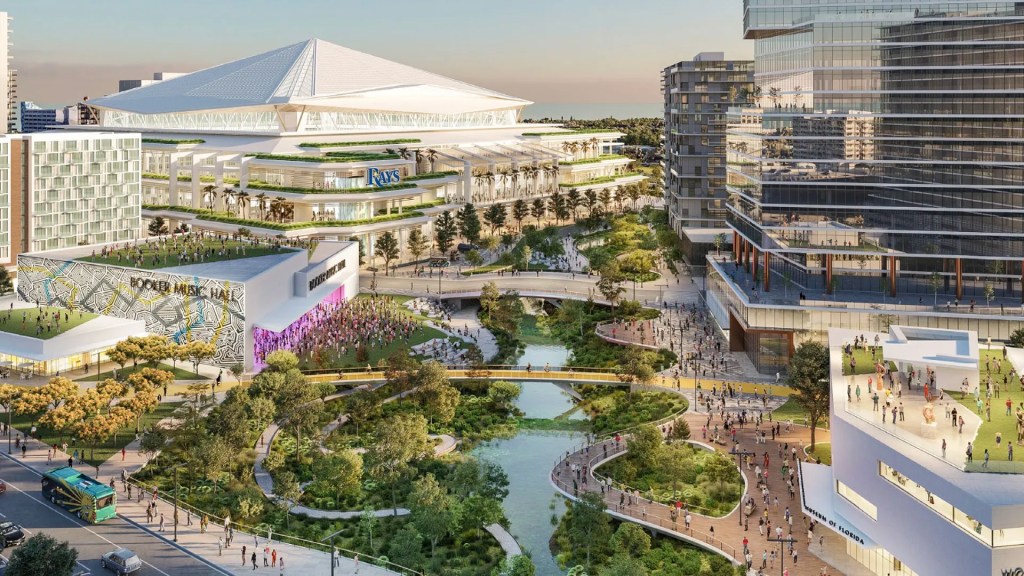
St. Petersburg is set to vote on a bond issuance to finance the city’s contribution to a new Tampa Bay Rays stadium, but it might not make a difference.
Before the delayed bond vote on Tuesday evening, the Rays sent a stern letter to Pinellas County commissioners. Rays presidents Brian Auld and Matt Silverman stated that the commission’s October 29 decision to postpone approving a perceived formality rendered the agreements approved in July financially unfeasible.
The commission postponed the vote again and will revisit the critical measure on December 17. St. Petersburg officials discussed their upcoming bond issuance at a Thursday morning committee meeting.
Councilmember Lisset Hanewicz inquired if the Rays could abandon the deal—which includes the entire $6.7 billion redevelopment project—without penalty until March 31. City Attorney Jackie Kovilaritch confirmed this was possible.
“So, the county can approve the bonds,” Hanewicz continued. “We can approve the bonds, and they (the Rays) can still walk away, right?”
“Yes,” concurred Tom Greene, assistant city administrator.
Kovilaritch explained that the agreements do not require the commission or council to approve a bond sale. She also noted that team officials requested a penalty provision with unspecified liquidated damages, which was not included.
The Rays wrote that it was “known and accepted” in July that the county needed to adopt its bond resolution by the November 5 election to open the new ballpark by 2028. Voters recently elected two new commissioners with varying levels of deal opposition to replace two staunch supporters.
The city passed its initial master bond resolution and related agreements in July. However, the team’s letter stated they suspended extensive work on the stadium and 30-year redevelopment project due to “the county’s failure to live up to its July agreement.”
The full council will vote on a supplemental bond resolution and validation—part of a complex process—later Thursday afternoon. Hanewicz asked if the council was contractually obligated to hold a vote today. Kovilaritch said it was not required.
Hanewicz then asked if the “heavily negotiated agreement” stipulated that the city or county must vote on the issuance before an election or any other date. “There’s nothing that I recall,” Kovilaritch said.
“I just wanted to make sure what they said in their letter, in terms of the county’s commitment and all that, the reality is, we don’t have to approve this,” Hanewicz said.
Mayor Ken Welch began the meeting by noting that unexpected developments have impeded the Historic Gas Plant District’s redevelopment. He also believes there is still a “path to success.”
However, Welch said that requires the city to fulfill previously approved, “painstakingly negotiated” agreements. The plan’s success also requires the county and Rays to remain willing partners.
“Given that context, we think it’s important that we as a city complete the necessary steps to finalize funding for our commitments—our share of the stadium and infrastructure costs—so we can fulfill our obligations under the agreement,” Welch added. “These bonds are based on the overall city contribution that was approved by the city council. There are no additional funds being requested.”
Auld and Silverman wrote that Hurricane Milton shredding Tropicana Field’s roof “devastated the organization.” The city is responsible for over $55 million in repairs, and Welch reiterated his intention to cover the costs.
City Administrator Rob Gerdes told the commission Tuesday night that a Federal Emergency Management Agency (FEMA) reimbursement could potentially cover between 75% and 85% of the Trop’s repair costs. Insurance proceeds will also help lessen the financial burden.
Gerdes said the team may have played its last inning at the Trop. However, that would require “some type of settlement” with the team to void the city’s current use agreement.
Commissioner Chris Latvala then asked if the Rays could request a check for the repair costs and continue playing in Tampa for the foreseeable future. “We’ve certainly had discussions with the team about that,” Gerdes replied.
“I’m not going to go into specific numbers in a public setting,” he said. “It’s more fiscally responsible for us to repair the stadium.”
Follow us on Facebook, Instagram, Threads, Google, & X
(Image credit: Courtesy of Hines/Tampa Bay Rays)



 St. Pete-Clearwater Sun
Leave a comment