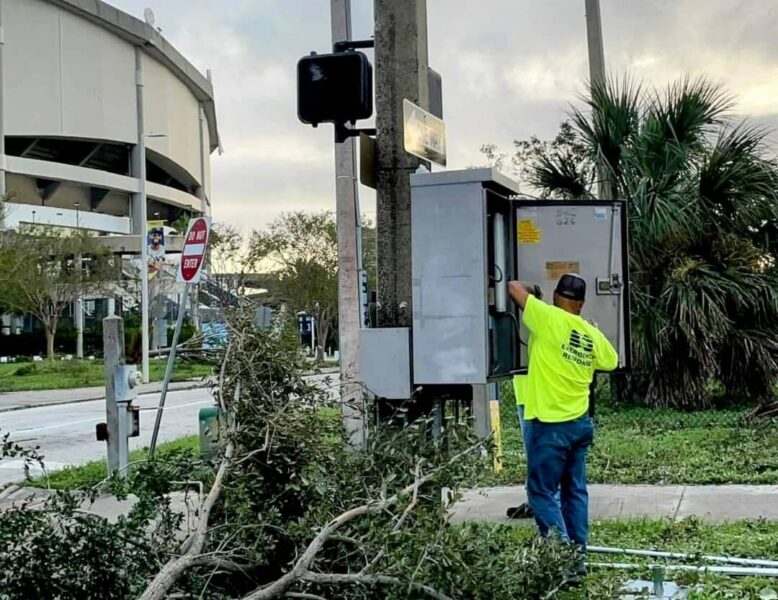
A St. Petersburg-based think tank has highlighted how Florida’s outdated traffic signals contribute to pedestrian-involved crashes, longer commutes, and increased greenhouse gas emissions.
The report, “Best Practices: Signalized Intersection Investments,” emphasizes the urgent need to enhance signal timing and responsiveness using artificial intelligence (AI) and new technologies. The Florida Policy Project (FPP) released the study on Tuesday.
Conducted by the University of South Florida’s Center for Urban Transportation Research (CUTR) with a grant from the Tampa Hillsborough Expressway Authority, the study calls for action. Former Sen. Jeff Brandes, president of the FPP, stated, “The overarching goal is to show the best return on investment in all of transportation is fixing your traffic signals.” Brandes believes the time is ripe to leverage AI and machine learning to modernize infrastructure.
Brandes, a St. Petersburg resident, also urges Florida’s leadership to storm-harden traffic signals. During Hurricane Helene, dozens of signals in the city lost power, a number that soared to over 100 following Hurricane Milton.
“There’s an opportunity for us to improve the power capacity of these facilities,” Brandes added. “But frankly, the number one thing coming out of this is it will improve the lives of the traveling public.”
CUTR researchers found that 26.3% of statewide crashes occurred at intersections, with 32.2% leading to injuries or deaths. Vulnerable road users (VRUs) like pedestrians and cyclists accounted for 23.4% of traffic fatalities.
The report indicates that 83.4% of intersection crashes involving VRUs result in injury or death, with the demographic’s fatality rate increasing by 7.4% annually between 2019 and 2023. Despite a 20% decrease in traffic accidents from 2019 to 2020, intersection-related fatal crashes rose by 5%.
Brandes emphasizes the need for timely investments: “We’re saying, make them sooner and improve everybody’s lives now.”
CUTR analyzed 16,694 signalized intersections statewide, revealing an average delay per vehicle of 20.4 seconds, compared to the national average of 18.1. The total daily delay per signal was 178.3 hours, far exceeding the national average of 117.4. This resulted in vehicles emitting an additional 1,328 pounds of carbon dioxide (CO2) into the atmosphere daily.
Brandes points out that Florida is a national leader in self-driving vehicle, electric vehicle, ride-sharing, and electric scooter and bicycle policies. He believes “smart” traffic signals that better accommodate VRUs are a natural progression for the Florida Department of Transportation (FDOT) and industry partners.
“This doesn’t require us to build new roads and bridges,” Brandes added. “This is simply taking the existing infrastructure and making it work better, which I think we can all agree is a better outcome we all want.”
The FPP report’s stakeholders believe AI and other rapidly advancing technologies can bring unprecedented safety and mobility improvements to signalized intersections. They also stressed the need for equitable implementation.
“In downtown St. Pete, if you drive 30 miles per hour, you can pretty much get all the lights because they’re timed for a 30-mph run,” Brandes noted. “As soon as you make one turn off the major streets, you’re stuck. Well, it doesn’t have to be that way. We can have a system that operates holistically by utilizing these technologies and upgrading the sensors and software.”
The report states that 25% to 40% of signalized intersections nationwide support adaptive control systems. Digitizing an intersection would cost between $200,000 and $500,000. However, implementing upgrades at scale would drastically reduce costs and create a “massive impact” over time. The study’s best practices for modernizing intersection infrastructure include:
- Short-term: Digitize existing infrastructure for consistent data collection and foster collaborative partnerships and workforce development to optimize resources and accelerate technology deployment.
- Medium-term: Develop uniform statewide protocols and guidelines for systematic maintenance and software upgrades and promote open-data initiatives for intersection management to foster innovation and transparency.
- Long-term: Invest in future-proof design elements to ensure adaptability with evolving technologies and set performance-driven investment goals.
“This isn’t a question of when we get these signalized intersections upgraded – it’s a question of when,” Brandes said. “We’re pushing for the Legislature to make those investments now.”
Follow us on Facebook, Instagram, Threads, X
(Image credit: City of St. Petersburg)

 St. Pete-Clearwater Sun
Leave a reply to January is ‘Move Over Month’ in Florida: What You Need to Know About This Traffic Law – St. Pete-Clearwater Sun Cancel reply