
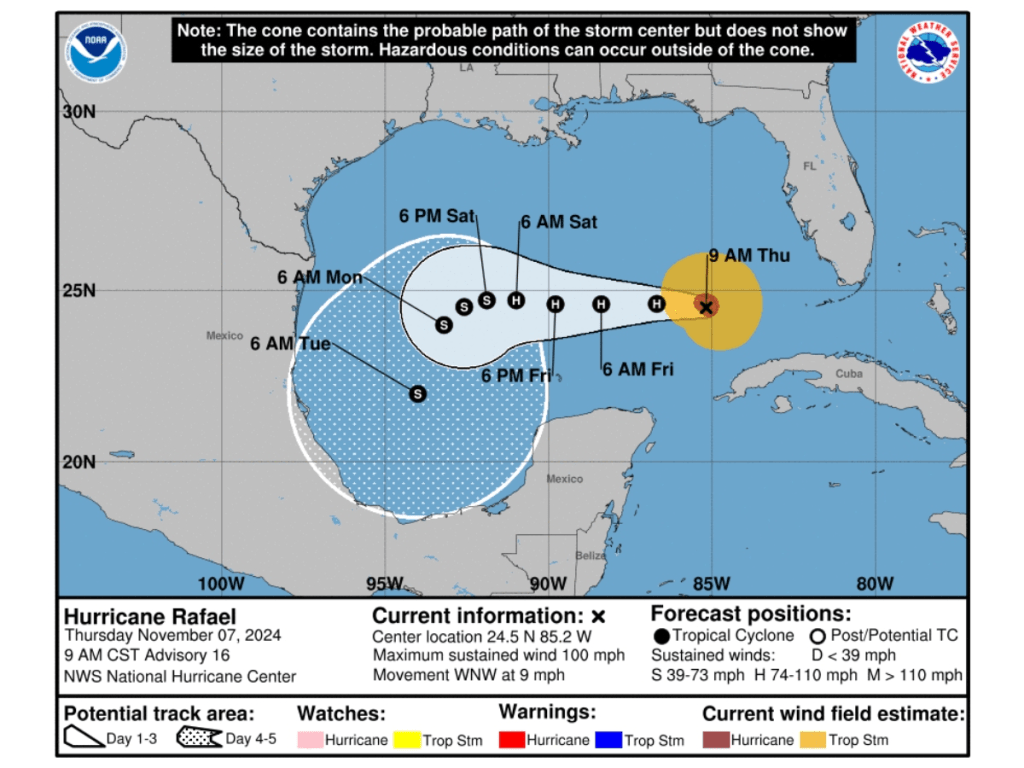
As Hurricane Rafael moves westward into the Gulf of Mexico after sweeping across Cuba as a Category 3 storm, Florida’s Gulf Coast is expected to experience coastal flooding, rip currents, and minor impacts, forecasters report.
The National Hurricane Center (NHC) notes that Rafael caused widespread power outages, downed trees, and infrastructure damage in Cuba before its westward track led it into the Gulf. While initially close to Florida’s west coast, the storm will continue moving away, likely sparing Florida any significant impact.
Early Thursday morning, ABC Action News Chief Meteorologist Denis Phillips shared, “Rafael made its closest approach to the Florida coast, and today it will turn west. It’s possible Rafael may never make landfall in the U.S., despite reaching the Gulf.”
The National Weather Service (NWS) has issued a high rip current risk, extending from Thursday morning through Friday night for several counties along Florida’s Gulf Coast, including Pinellas, Hillsborough, Manatee, Sarasota, Charlotte, and Lee. The NWS advises:
- Swim near a lifeguard.
- If caught in a rip current, relax and float.
- Avoid swimming against the current; instead, swim parallel to the shoreline if possible.
- If unable to escape, face the shore and signal for help.
AccuWeather indicates that minor coastal flooding is possible in the Florida Keys and parts of Southwest Florida on Thursday. Rafael’s movement will continue to create strong rip currents along the Gulf Coast through the weekend.
In Cuba, heavy rainfall will persist, leading to possible flash floods and mudslides in western regions, per the NHC. Moving forward, Rafael is forecast to drift slowly over the south-central Gulf of Mexico this weekend and early next week, where it’s expected to weaken due to increased wind shear.
“We can expect Rafael to weaken significantly by early next week as it encounters strong wind shear,” Phillips added.
The Weather Channel reports that Rafael is likely to stay on a westerly path toward the Mexican Gulf Coast, though remnants could bring rain along the northern U.S. Gulf Coast if pulled by an approaching cold front.
Follow us on Facebook, Instagram, Threads, X
(Image credit: National Hurricane Center)



 St. Pete-Clearwater Sun
Leave a comment