
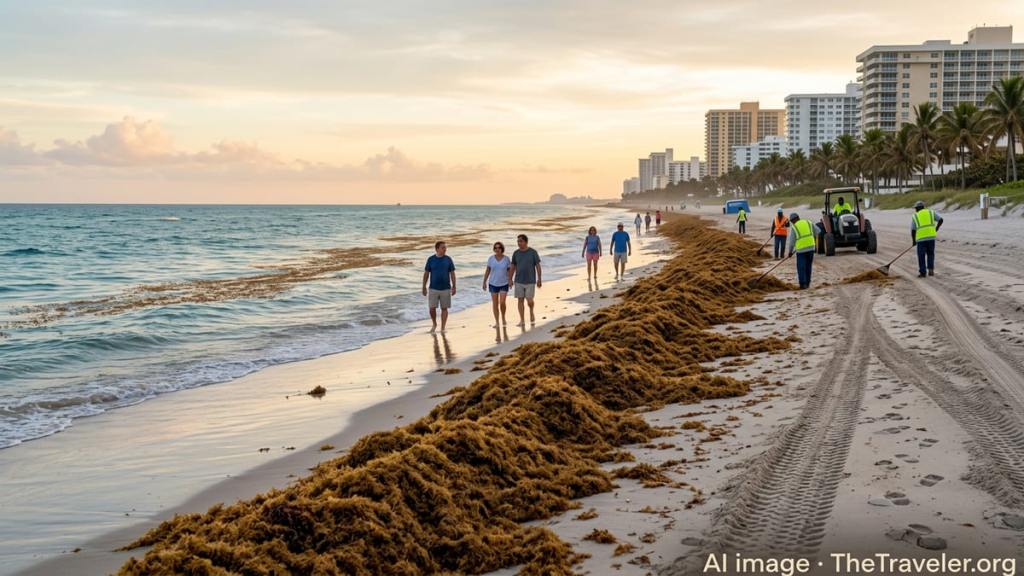
Researchers are warning that 2026 is shaping up to be another major year for sargassum, the brown seaweed that has increasingly fouled beaches across Florida and the Caribbean in recent years.
The floating seaweed clumps grew from an estimated 9.5 million tons to 13.6 million tons in just one month and are expected to keep growing as temperatures warm. Researchers at the University of South Florida said at the end of February that 2026 is set to be another major sargassum year, citing continuous growth from November through February and record-high amounts across most regions.
Dr. Chuanmin Hu, a professor of oceanography at USF, warned that “the worst is yet to come,” while noting that variable ocean currents and winds make it difficult to predict exactly how much will land on Florida’s shores. The forecast suggests sargassum could arrive in the Florida Keys in the coming weeks, with Broward and Miami-Dade County beaches estimated to see it in April or May.
Parts of the Caribbean — including Mexico, Belize, and Honduras — are already seeing sargassum on their beaches. The Lesser Antilles, the island chain stretching from east of Puerto Rico to Aruba, is expected to be hit next.
The seaweed poses little problem while floating at sea, but becomes a nuisance once it washes ashore. When it rots on land, sargassum emits hydrogen sulfide, which smells like rotten eggs and can cause breathing problems for people with sensitivities. Research by Florida Atlantic University also found that the pathogen Vibrio — which includes species sometimes referred to as flesh-eating bacteria — can attach to microplastics that merge into sargassum clusters at sea, though it has not yet been detected in seaweed that has washed ashore.
Cleanup and mitigation efforts cost millions of dollars, with Miami-Dade and Broward counties planning to rake and mix the seaweed along the coast to keep beaches manageable. The Florida Department of Health advises beachgoers to avoid touching or swimming near sargassum and recommends closing windows near the beach to limit exposure to the smell and potential respiratory irritants.
Follow the St. Pete-Clearwater Sun on Facebook, Google, & X
St. Pete-Clearwater Sun: local St. Pete-Clearwater news at PIE-Sun.com


 St. Pete-Clearwater Sun
Leave a comment