
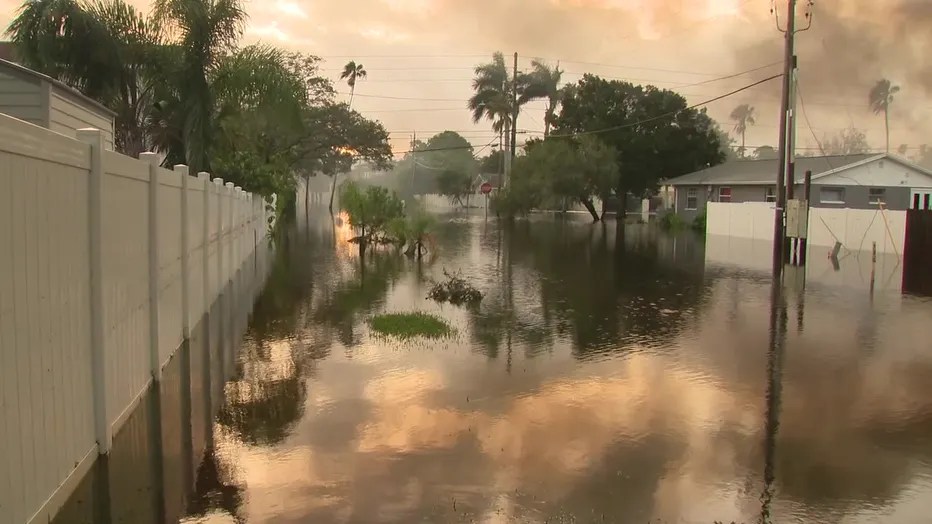
A new report from the Resilience Action Fund, a nonprofit promoting sustainable building practices, shows property values in St. Petersburg’s Shore Acres dropped following last year’s storm season—while prices in a nearby, less flood-prone neighborhood went up.
The study analyzed 36 single-family homes in Shore Acres that were purchased between 2000 and 2024 and sold for under $400,000 within the five months following Hurricane Milton. On average, those homeowners lost 35%—about $140,000—before accounting for repairs, closing costs, or temporary housing.
“For a young, working-class family, the consequence is significant,” said Aris Papadopoulos, the fund’s founder and author of the study. “It sets them back one or two decades in terms of wealth building.”
Timing made the losses sharper. Home prices surged during the COVID-19 migration into Florida, with buyers paying inflated prices in flood-prone areas without fully understanding the risks, Papadopoulos said.
By contrast, homes in Disston Heights—an inland neighborhood at a higher elevation—fared much better. Of 21 homes bought during the same period and sold after the storms, owners gained an average of 25%, or about $60,000.
Not everyone agrees with the report’s conclusions. Kevin Batdorf, a broker and president of the Shore Acres Civic Association, said the analysis ignores insurance payouts that offset some losses. He noted that many early sellers were simply desperate to get out.
“The sharks come in and say, here’s cash,” Batdorf said. “They’ll walk away from a mortgage and just say I’m done with it, I’m out.”
Batdorf believes property values will rebound as more residents elevate their homes, aided by Elevate Florida, a new state program funding floodproofing for more than 100 houses in Shore Acres.
Still, both Batdorf and Papadopoulos agree that buyers need better information on flood risk. Florida only recently required sellers to disclose if they’ve filed flood insurance claims or received FEMA assistance, leaving gaps in transparency.
“It should be black and white,” Batdorf said. “Did this house flood, and how high did it come in?”
Papadopoulos argued that FEMA’s outdated maps do not accurately capture real storm surge or rainwater threats. He urged local governments to share more data, and suggested buyers use private tools like Zillow or Redfin, which assign each property a climate risk score.
“We have a buyer-beware property market,” Papadopoulos said. “You have to be your own detective, you have to do your own homework.”
Follow the St. Pete-Clearwater Sun on Facebook, Instagram, Threads, Google, & X
(Image credit: WTVT)
PIE-Sun.com: local St. Pete-Clearwater news


 St. Pete-Clearwater Sun
Leave a comment