
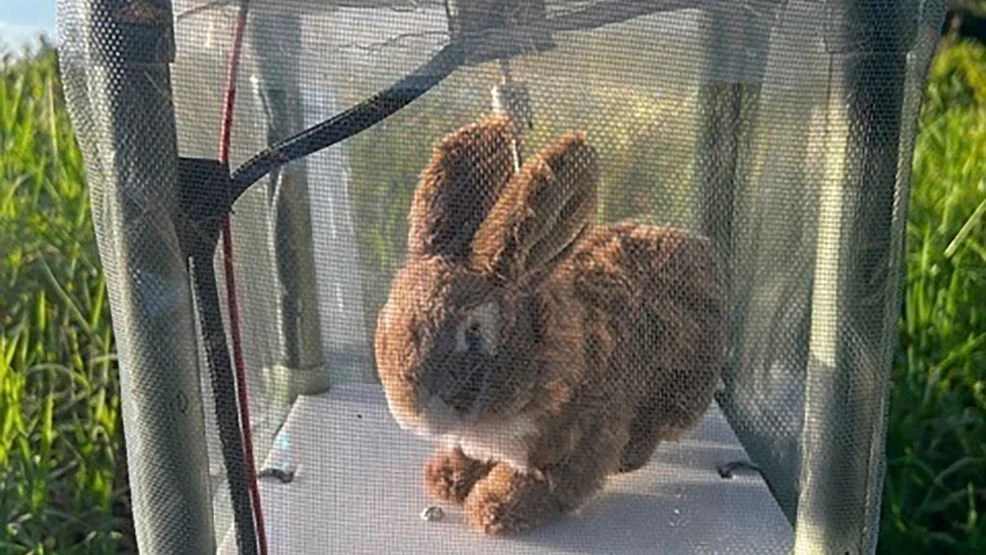
They hop, move, and even give off the scent of a marsh rabbit — but these aren’t real bunnies. They’re robotic decoys designed to lure out Burmese pythons, one of the Everglades’ most destructive invasive species.
The South Florida Water Management District has launched the experimental program in partnership with University of Florida researchers, hoping to remove more of the giant snakes that have devastated native wildlife. In some areas of Everglades National Park, scientists report that pythons have eliminated up to 95% of small mammals and thousands of birds.
“The problem isn’t catching them — it’s finding them,” said Mike Kirkland, the district’s lead invasive animal biologist. “They blend in perfectly with their surroundings.”
This summer, 120 robot rabbits were placed in monitored pens across the Everglades. Outfitted with heating elements, natural movements, and a rabbit-like scent, the solar-powered decoys mimic real prey. When a python approaches, the system alerts researchers, who then send contractors to remove the snake. Each robotic lure costs about $4,000, funded by the district.
Earlier attempts used live rabbits, but the effort proved too costly and time-consuming. “The robots look and act like the real thing,” Kirkland said.
Burmese pythons, often released into the wild after outgrowing captivity, now number in the tens of thousands — possibly as many as 300,000 — according to federal and state estimates. Females can lay up to 100 eggs at a time, fueling their rapid spread. With few natural predators, they average 10 to 16 feet in length and pose a major threat to Florida’s ecosystem.
Since 2000, more than 23,000 pythons have been removed from the wild. Efforts include year-round hunts, private land removals, and the annual Florida Python Challenge, which this year drew nearly 1,000 participants and resulted in the capture of 294 snakes.
Officials say it’s too early to judge the success of the robotic rabbit program, but early signs are encouraging.
“This project is still in its infancy, but we believe it can become an effective tool,” Kirkland said. “Every python we remove makes a difference for Florida’s native wildlife.”
Follow the St. Pete-Clearwater Sun on Facebook, Instagram, Threads, Google, & X
(Image credit: South Florida Water Management District)
PIE-Sun.com: local St. Pete-Clearwater news



 St. Pete-Clearwater Sun
Leave a comment