
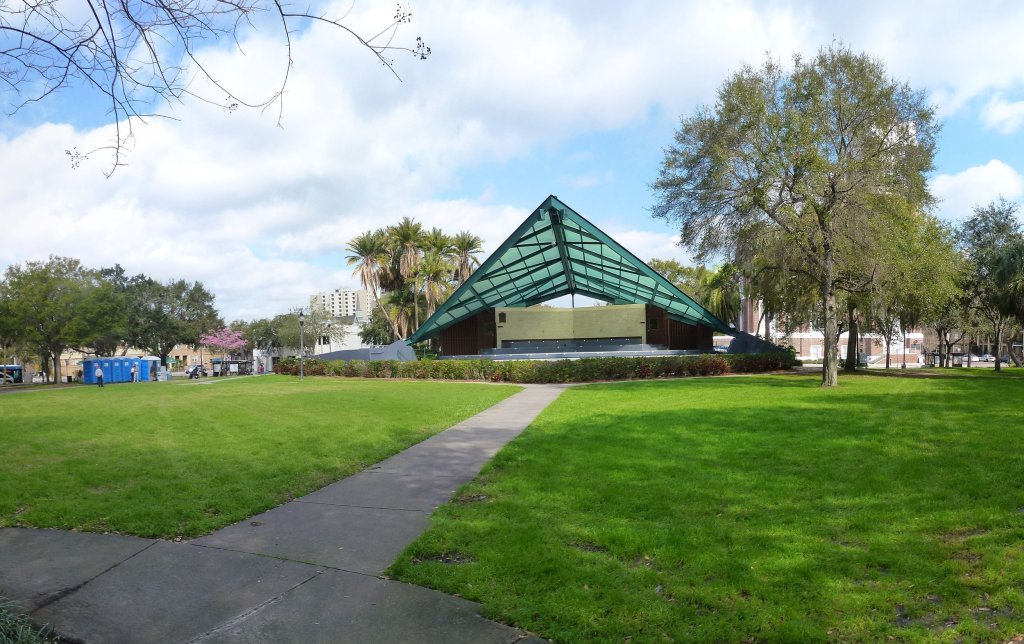
Major investments and new leadership are advancing long-planned initiatives to transform Williams Park and launch St. Petersburg’s first Downtown Improvement District.
A nonprofit organization has secured $800,000 in state funding to upgrade the city’s oldest park, established in 1888. The city previously committed $1.2 million to restore the park’s historic bandshell, designed by architect William B. Harvard in the early 1950s.
These improvements align with the St. Petersburg Downtown Partnership’s development of a comprehensive “Clean and Safe” urban management program. Shaun Drinkard, former Senior Vice President of Public Programming and Operations at Tampa Downtown Partnership, now leads this effort as vice president of the St. Petersburg partnership.
Drinkard clarifies that the $800,000 state funding targets infrastructure improvements exclusively and won’t support Clean and Safe operations. “There are layers to the Clean and Safe program that would absolutely touch the long-term success of the park,” he explains. “We’re looking at power improvements, lighting improvements, landscape enhancements – creation of rooms, I think, is a really big thing.”
The infrastructure focus includes creating designated spaces for different activities. Drinkard notes certain park areas naturally accommodate specific uses, such as fitness classes requiring electrical access. “It’s just those little nuances of the infrastructure that are important. Then we can simply plug in all these different programmatic elements.”
Councilmember Gina Driscoll, who represents the district, praised the partnership’s fundraising success. “This is the boost we needed to make the park more functional for events that bring our community together,” she said.
The Williams Park Partnership, established in 2016, submitted the state funding request. Their proposal emphasized improvements to safety, security, and pedestrian connectivity. Downtown Partnership CEO Jason Mathis handled the application process, with both organizations working toward shared objectives despite their separate structures.
St. Pete officials plan to begin the estimated $1.95 million renovation by year’s end. The project will expand performance and event capacity while preparing the facility for historic designation status, as outlined in January 2023 plans.
Coordination between stakeholders remains essential. A city spokesperson confirmed administrators are conducting “early discussions with the downtown partnership and look forward to continued collaboration to revitalize this key community asset.”
Plans include establishing regular programming at multiple intervals – weekly, monthly, quarterly, and annually. “For a park like this, like an urban town square, we need those recurring activities that people will go to every week,” Drinkard said.
Expected programming encompasses cultural events, culinary experiences, and recreational classes. The ultimate vision positions the park as a communal “front lawn” welcoming all residents, regardless of housing status.
Drinkard brings experience from Tampa’s Curtis Hixon Park revitalization. He and other stakeholders believe active programming creates community ownership, naturally promoting cleanliness and safety. “When you just have something that looks really pretty with no purpose, then it’s hard to say what’s going to happen,” he noted.
Downtown Improvement District Initiative
The improvement district will provide operational support for the Clean and Safe Program. Drinkard, a 20-year St. Petersburg resident, helped establish Tampa’s nationally recognized downtown initiative and now applies this expertise locally.
Driscoll characterizes the program as addressing essential needs “the St. Pete way.” She credits Drinkard’s leadership: “When you look at the success of Tampa’s Downtown Improvement District today, it comes down to the passion and expertise of one person: Shaun Drinkard. Shaun is bringing the experience and knowledge base we need to take the Downtown Partnership’s work to the next level.”
Drinkard acknowledges St. Petersburg’s existing strengths – the waterfront park system, St. Pete Pier, and signature event hosting capability. The improvement district addresses fundamental urban management elements often overlooked amid major developments.
“There’s a need for a connector and the knowledge for the in-betweens,” Drinkard explains. “We have amazing development taking place, and great infrastructure within the pedestrian spaces, but there are always those little gaps.”
His urbanist perspective identifies maintenance needs – missing waste receptacles, areas requiring additional cleaning, or other infrastructure gaps. “You have a lot of stakeholders within a tight space, and there needs to be a common voice to ensure continuity,” he adds.
Funding mechanisms remain under discussion. Potential revenue sources include municipal parking proceeds and Intown Community Redevelopment Area tax income to support the estimated $1.5 million annual operating budget.
Tampa’s program employs approximately 30 staff across 1,100 acres with a $6.6 million budget. St. Petersburg’s district would initially cover 200-300 acres – a smaller scale enabling more detailed attention.
“But with that scale comes the ability to focus on a lot of detail,” Drinkard concludes. “From the waterfront to Williams Park … we can ensure we’re giving a lot of very high-quality attention, block by block.”
Follow the St. Pete-Clearwater Sun on Facebook, Instagram, Threads, Google, & X
(Image credit: St. Pete Rising)
PIE-Sun.com: local St. Pete-Clearwater news


 St. Pete-Clearwater Sun
Leave a comment