
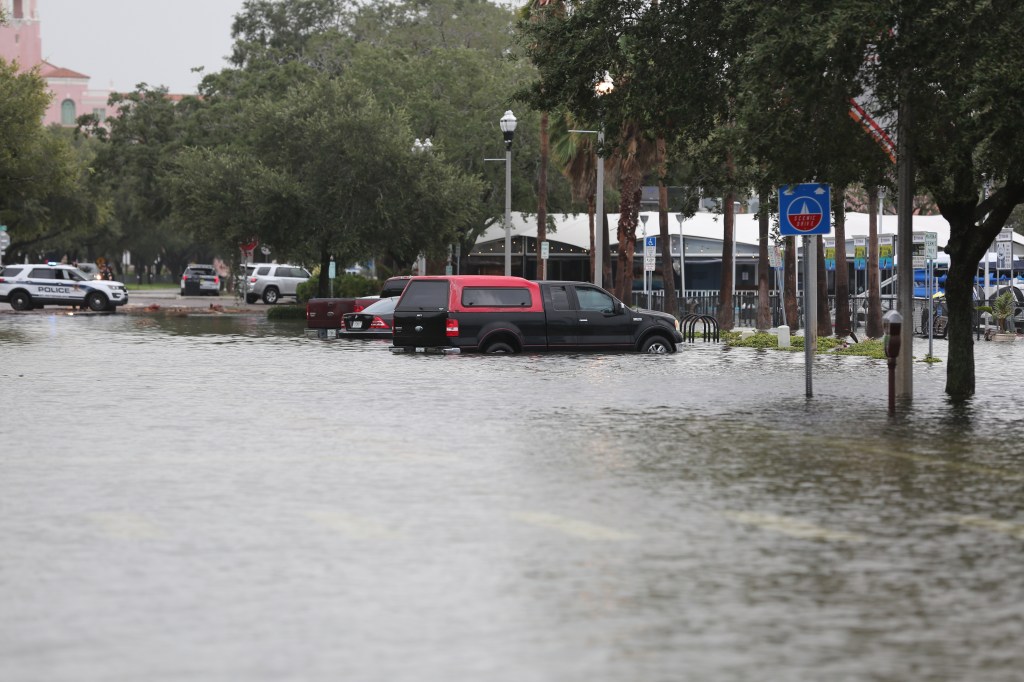
Facing more frequent and severe storms, St. Petersburg is pushing forward with $614 million in accelerated stormwater upgrades — but without a fully developed plan to fund them.
The city’s current utility revenues are enough to maintain day-to-day operations, but not the scale of upgrades needed. With many residents already feeling the pinch of recent rate hikes, city officials are now weighing a new property tax as a potential funding source.
Voters could decide the issue in a 2026 referendum, where they’d be asked to approve general obligation (GO) bonds to help finance the city’s SPAR (St. Pete Agile Resiliency) initiative. Some city council members support the idea, arguing it would more fairly distribute the financial burden across all property owners — not just residents — through property taxes.
“The rate increases alone are becoming unsustainable,” said Councilmember Mike Harting. “If we tried to cover all of this without debt, we’d be looking at a 75% rate hike. I don’t think they’d burn me in effigy — they’d just burn me.”
Utility bills in the city are already set to rise by about 9% in fiscal year 2026, starting October 1. Stormwater fees could jump by 17.5% that year, and possibly by 75% in 2027 if no alternative funding is secured.
Some officials favor a 50-50 split, using both debt and utility fees to fund SPAR. That approach would soften rate increases over time, with a 7.5% hike anticipated in 2028.
SPAR is one of several climate resiliency efforts in the city’s long-term Stormwater Master Plan, which outlines $1 billion in needed improvements over the next two decades.
Councilmember Brandi Gabbard has repeatedly warned that a new property tax will not be a cure-all. “This won’t fix everything,” she said. “Even with 30 years of new property taxes, we won’t cover the full cost.” She suggested issuing a limited amount of debt without waiting for a voter referendum to get key projects moving.
Waiting for the 2026 vote could delay funding until at least spring 2027 — a timeline Gabbard called unacceptable.
In the meantime, the city plans to spend about $10 million on SPAR planning and early work next year, including flood barriers at critical sewer infrastructure.
“We think it’s important to give property owners a voice,” said City Administrator Rob Gerdes. “If the referendum fails, that sends a clear message to continue with our current capital improvement plan.”
GO bonds, last used by the city in 1980, are backed by property taxes and offer low interest rates. Consultant Andy Burnham noted they are “the lowest cost of capital” available to local governments.
Council Chair Copley Gerdes said he’s open to adjusting the funding model for SPAR — if it’s a temporary measure — but remains cautious. The GO bonds would offer flexibility: If the city secures grants or other funding, it could borrow less than the voter-approved maximum, minimizing the tax impact.
Unlike utility rate hikes, which tend to remain in place indefinitely, bond-funded debt would eventually expire. Harting emphasized that a tax-funded approach would also shift some burden to commercial and multi-family property owners.
While 58% of St. Pete’s nearly 108,000 properties are homesteaded residences, non-homesteaded properties — including businesses and rentals — represent 60% of the city’s $33.8 billion taxable value.
The City Council will revisit the issue in August, with staff expected to present a prioritized list of SPAR projects and further research on referendum requirements.
Councilmember Lisset Hanewicz believes a clear and well-communicated plan will be key. “If it’s important to people and they understand it, I believe they’ll vote for it,” she said. “But clarity is critical.”
Follow the St. Pete-Clearwater Sun on Facebook, Instagram, Threads, Google, & X
(Image credit: Jennifer Glenfield/Tampa Bay Times)
PIE-Sun.com: local St. Pete-Clearwater news

 St. Pete-Clearwater Sun
Leave a comment