
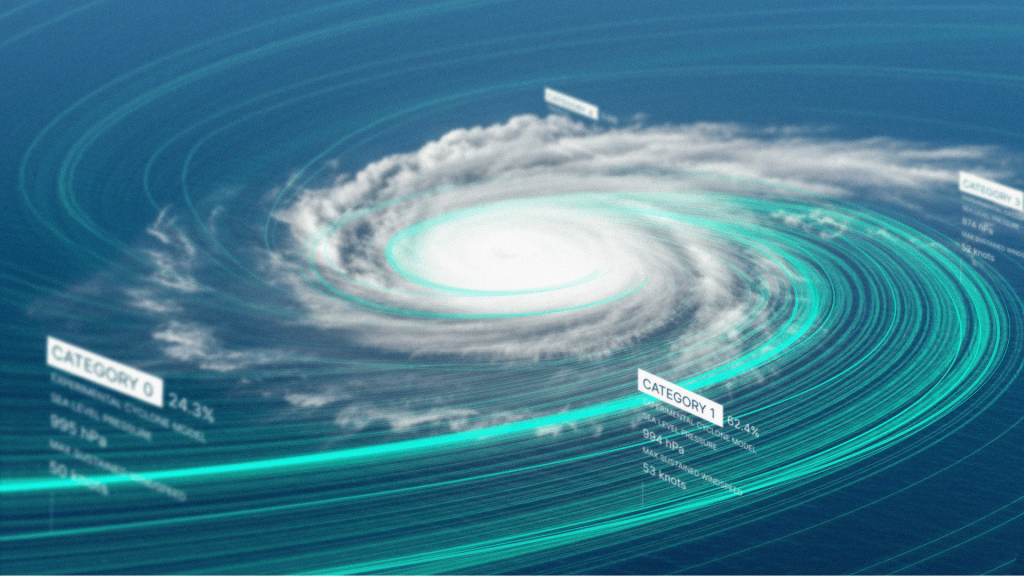
Earlier this month, Google DeepMind and Google Labs unveiled a new AI-powered hurricane forecasting model — and they’re making bold claims about its performance. According to Google, this AI system delivers more accurate predictions than some of the world’s most trusted traditional models, both in terms of storm track and intensity.
But how well do those claims hold up?
Before diving into the data, let’s take a step back and look at how this AI model actually works.
Unlike traditional forecasting models like the ECMWF (European Centre for Medium-Range Weather Forecasts) or the GFS (Global Forecast System), which rely on physics-based equations to simulate atmospheric behavior, Google’s model takes a different approach. Traditional models solve equations related to fluid dynamics, thermodynamics, and radiation on a global grid — a process that requires supercomputers and can take hours to complete a single forecast run. (It’s worth noting, though, that ECMWF has also developed its own AI-enhanced model.)
Google’s AI model, on the other hand, uses a neural network trained on decades of historical weather data. It recognizes complex patterns in past storm behavior, allowing it to generate forecasts in a matter of minutes — without having to solve the complicated math behind weather systems.
Like the ECMWF, Google’s model produces an ensemble of 50 slightly varied forecast scenarios to account for uncertainty — offering a range of possible outcomes instead of a single prediction.
Google reports that during tests on storms from the 2023–24 seasons in the North Atlantic and East Pacific, its model produced 5-day track forecasts that were, on average, about 85 miles closer to actual storm paths than ECMWF’s ensemble model. It also claims to have beaten NOAA’s top intensity model, HAFS, in several key scenarios.
To put it to the test, WFLA analyzed the model’s performance during two of last year’s most significant storms — Hurricanes Helene and Milton.
The AI model performed impressively for track forecasts, predicting paths just a few miles off from the actual storm tracks days in advance. In these cases, the storm tracks were relatively straightforward, and most models were within a similar range. Still, Google’s results stood out for their precision.
Regarding intensity forecasts, the AI model’s performance was more mixed. It did reasonably well with Helene, but significantly underestimated the strength of Milton. That’s not entirely surprising — predicting storm intensity remains one of the biggest challenges in meteorology.
Ultimately, while Google’s AI hurricane model shows promising results, it’s still early. More storms and more data will be needed to fully evaluate its reliability. As the 2025 hurricane season unfolds, forecasters and researchers alike will be keeping a close eye on how this new tool performs in real-time conditions.
Follow the St. Pete-Clearwater Sun on Facebook, Instagram, Threads, Google, & X
(Image credit: Google)
PIE-Sun.com: local St. Pete-Clearwater news



 St. Pete-Clearwater Sun
Leave a comment