

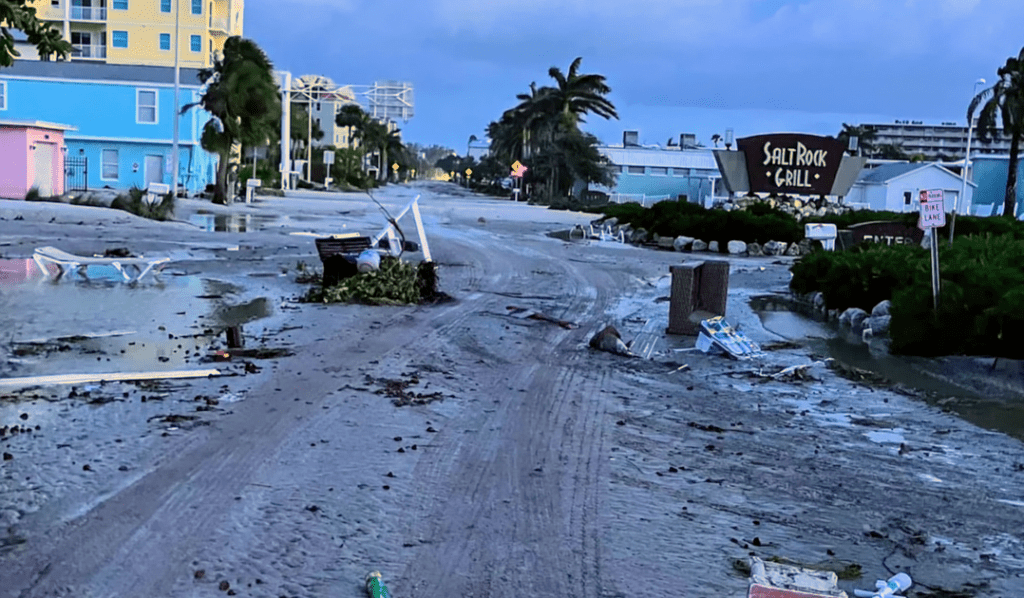
After Hurricane Helene tore through Florida last year, many residents along the coast are still displaced and working to rebuild before the next hurricane season begins on June 1. Experts say the aftermath could lead to major changes in local and state land development codes, aimed at making homes stronger and more flood-resilient.
In response to a callout from WUSF, Floridians in Pinellas, Pasco, and Hernando counties shared how they’re redesigning their homes—not just to recover, but to prepare for the storms yet to come.
Pinellas County: Building Back With Flooding in Mind
In Shore Acres, a neighborhood plagued by chronic flooding, federal biologist Michael Larkin is watching new tile floors go in—tiles that mimic the look of wood but can survive saltwater floods.
“It’s not real wood, so when it floods again, we don’t have to replace it,” Larkin explained to WUSF. “We’ll still have to deal with the drywall, though.”
His family home took in over a foot of saltwater during Hurricane Helene, destroying hardwood floors and forcing the removal of two feet of drywall throughout the house.
For months, Larkin, his wife, and their two children have been living in temporary rentals, juggling home repairs and permit delays. While flood insurance is covering much of the reconstruction, the financial and emotional toll is building.
“I’ve lost my temper more, argued more with my family—we’re all on edge,” he said, adding that he’s noticed his children’s school performance and mood have suffered as well.
“This feels like the world’s longest road trip. I just want to go home—but I can’t yet.”
Larkin’s story mirrors that of many Floridians who have chosen to stay put, rebuilding with future floods in mind.
Pasco County: Flood Damage Spurs Major Home Upgrades
Roughly 50 miles north in Hudson, insurance broker Steve Papola is also deep into recovery efforts. Hurricane Helene flooded his single-story home with four feet of saltwater.
“When I saw the damage and my wife crying, I knew I had to find a rental—fast,” Papola said. He, his wife, and their family have been living in Brooksville while waiting for repairs.
Their renovations include replacing Brazilian cherry wood floors with tile and elevating electrical outlets. Papola also considered lifting the entire house, but found it too expensive for now.
Like Larkin, Papola’s family is dealing with both a mortgage and rent, while insurance helps cover the cost of repairs. But he worries about who will be able to afford to live in these areas in the future.
“The coast is becoming unaffordable for the middle class unless you can fully insure and afford to rebuild after a storm,” he said.
Hernando County: Rebuilding From Scratch at Higher Ground
Further north in Weeki Wachee, Charlotte Wright and her husband are rebuilding their home from the ground up—this time, at an elevation of 15 feet.
Helene’s five-foot storm surge destroyed everything they owned. “Furniture, clothes, appliances—gone. It was total devastation,” Wright said.
Without flood insurance, the couple is paying out of pocket to rebuild. “We were quoted $18,000 a year for flood insurance. That’s just not doable,” she said.
Still, Wright is determined to stay. The new house will be elevated and open underneath to avoid future flood damage.
“There’s no place like home—and for me, home is the water,” Wright said, holding back tears as manatees surfaced near her riverfront property. “If you’ve never lived on the water, you can’t understand. But once you have, nothing else compares.”
Raising the Standard: Local Codes May Soon Shift
Pasco County’s building official JP Murphy says more homes are being forced to meet higher standards. Under federal guidelines, if a structure is more than 50% damaged, it must be either demolished or brought up to modern elevation and code.
“These rules help us build communities that can survive what’s coming,” Murphy said. “It’s about adapting to risks we didn’t face in the same way before.”
He expects the state to revisit its building codes, much like it did after Hurricane Andrew in 1992, to encourage more sustainable development in flood-prone areas.
Looking Ahead: Stay or Go?
Michael Larkin plans to move to higher ground once his kids graduate high school. “It’s the people—the community—that are keeping us here for now,” he said. “But next time it floods, we’re leaving.”
Steve Papola is restoring his home with future buyers in mind. “I want the next owner to feel secure. That means making sure it’s ready for another storm.”
Charlotte Wright, however, has no plans to leave.
“I’ve always lived by the water. It’s part of who I am,” she said, pausing as the sounds of manatees echo from the river. “This is home.”
Follow the St. Pete-Clearwater Sun on Facebook, Instagram, Threads, Google, & X
(Image credit: Matias J. Ocner/Miami Herald)
PIE-Sun.com: local St. Pete-Clearwater news


 St. Pete-Clearwater Sun
Leave a comment