
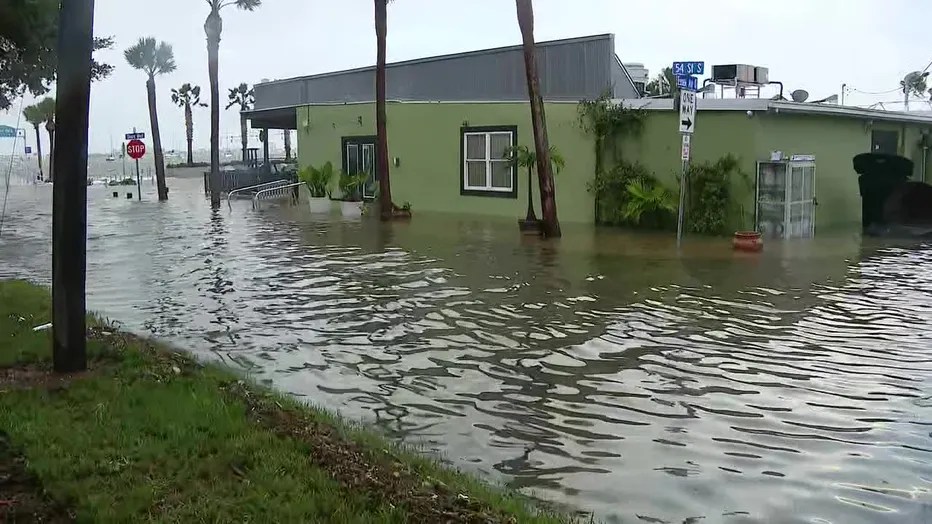
When Hurricane Milton struck last year, hundreds of homes far from the coast were inundated, exposing vulnerabilities in inland flood management. Now, local governments across the Tampa Bay region are reassessing how to prevent similar disasters.
In Land O’Lakes, Douglas Woods waded through three feet of water nearly a week after the storm submerged his neighborhood.
“I’ve lived here since ’94, and I’ve seen water in the garage a few times—but nothing like this,” he told WISF. “There’s no comparison.”
His neighborhood slopes toward Cypress Creek, but despite known flood risks, dozens of homes were approved there in the 1970s and ’80s.
In Sarasota County, Alexandra Coe has faced repeated flooding over the years, but Hurricane Milton overwhelmed her property like never before.
“First it was a 30-foot river, then 50, then 70,” she said. “That 70-foot river that swept through wasn’t even on the flood maps.”
Stories like theirs are common across the region. Milton dumped unprecedented rainfall, causing creeks, lakes, and streams to surge back into historic floodplains.
In Lakeland, a mobile home park near Lake Bonny remained underwater for weeks as the lake reclaimed areas where nearly 100 homes had been built. In northern Hillsborough County, residents were stranded after the only access road to their development became impassable, despite their homes being outside official flood zones.
Dick Abare of Carrollwood has watched flood risks grow alongside development.
“We were built in the ’70s, but newer developments changed everything,” he said. “You can’t stop growth, but the cost of ignoring infrastructure hits those of us who’ve been here the longest.”
The pressing question: Why were so many homes allowed in vulnerable areas—and what’s being done to stop it from happening again?
Tampa City Councilman Luis Viera reflected on the mistakes during a recent meeting.
“Too often we build first and ask questions later,” he said. “This season was a one-two punch, and Milton broke our jaw. We need to learn and prepare better.”
Officials say Milton followed another major storm, Hurricane Helene, creating a “perfect storm” that saturated the ground before Milton struck. Hillsborough County floodplain administrator Kyle Dollman said the region saw record-breaking rainfall, possibly representing a 500-year event.
Mitigating future floods won’t be easy—or cheap. Solutions include retention ponds, development limits, and property buyouts, but many vulnerable areas are already densely built.
“Buying up low-lying land means negotiating with private owners,” Dollman said. “And if it were undeveloped, it would probably already be serving as natural flood protection.”
Still, progress is underway. Sarasota County has updated its Watershed Master Plan, which maps natural waterways and wetlands and explores funding to protect them. After strong advocacy from residents, the county allocated $75 million in federal recovery funds to dredge Phillippi Creek and other flood-prone areas.
Consultant Fred Bloetscher of Florida Atlantic University is helping Sarasota develop more detailed stormwater models and targeted infrastructure fixes.
“Engineering solutions are possible,” he said. “But they must make sense for the community to move forward.”
Lakeland and Polk County are conducting similar studies to avoid repeat disasters, while Tampa and Hillsborough County are investing in new pumps and backup generators to keep stormwater systems running during outages.
Yet, as Dollman points out, there’s no quick fix.
“Much of the development predates current regulations,” he explained to WUSF. “You can’t just go back and ask homeowners to build a retention pond.”
Updated FEMA flood maps may eventually shift more homes into official flood zones, potentially requiring costly elevation or flood insurance.
At a recent meeting, Hillsborough Commissioner Harry Cohen emphasized that older infrastructure simply wasn’t built for today’s storms.
“They were designed for regular afternoon downpours—not 100-year events,” he said. “And now we’re paying the price.”
Cohen says there’s only one real choice: invest in stronger systems now or face the consequences again.
Follow the St. Pete-Clearwater Sun on Facebook, Instagram, Threads, Google, & X
(Image credit: WTVT)
PIE-Sun.com: local St. Pete-Clearwater news

 St. Pete-Clearwater Sun
Leave a comment