
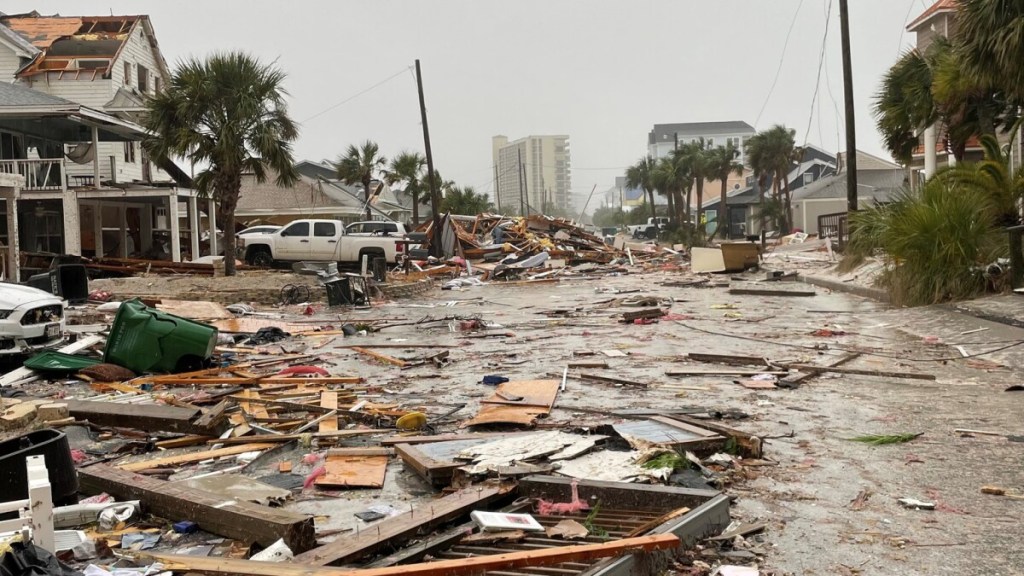
As St. Petersburg recovers from past hurricanes and braces for a new season, the city is facing a sharp decline in financial support. Compared to this time last year, the city has received $31.3 million less in grant funding — an 83% drop from $37.6 million to just $6.3 million through March.
The decline is expected to continue. The current fiscal year began in October 2024, under the previous presidential administration. Since then, federal leaders have slashed funding to multiple programs, including $882 billion from FEMA’s now-defunct infrastructure resiliency initiative.
City Council members received a report Thursday outlining grants accepted between Oct. 1 and March 31. Aubrey Phillips, director of strategic initiatives and grants, noted that while the city had great success with Florida’s resiliency program in 2024, its eight grant applications for 2025 were recently denied.
“We’re asking the Florida Department of Environmental Protection for feedback,” Phillips said, calling the rejections an opportunity to improve future submissions.
Despite the funding drop, the number of grants awarded — 21 — remained the same. One major source of hope is the $159.6 million St. Petersburg expects from HUD’s disaster recovery funds for its Sunshine St. Pete program. Still, city leaders are cautious, stressing the need to manage the funds properly to avoid having to return any due to compliance issues.
Some funding from previous years is still pending. Officials anticipate receiving $5.4 million from 2023, $12.4 million from 2024, and $548,410 this year — though uncertainties remain.
A separate $45.66 million request by St. Pete’s congressional delegation for community projects — nearly half of which targeted storm recovery — was denied on March 13. The blow came just weeks before FEMA, under new leadership, dismantled the Building Resilient Infrastructure and Communities (BRIC) program on April 4, labeling it “wasteful” and “politicized.”
The city had applied for $33.82 million through BRIC to upgrade sewage lift stations and reduce tidal flooding. With that gone, officials have turned to the state for $9.73 million in appropriations for five projects, including those previously tied to BRIC. They expect a decision by July.
Councilmember Brandi Gabbard said even if the state delivers $5 million for BRIC-related projects, it won’t be enough. “I’m very concerned with how we fill that hole,” she said, warning that completing those projects may require shifting substantial city funds.
One alternative is FEMA’s county-level Hazard Mitigation Assistance Grant program. St. Petersburg is preparing to compete for a portion of the $400 million expected to come to Pinellas County, applying for funding tied to Hurricanes Debby, Helene, and Milton.
Still, the long-term outlook is uncertain. Homeland Security Secretary Kristi Noem announced plans to eliminate FEMA entirely, a move that would further upend local funding strategies.
Phillips noted that the city won’t receive mitigation grant results in time to factor into a forthcoming utility rate study. Raising residential water, sewer, and trash rates may be necessary to offset the funding gap.
Looking ahead, the city has submitted eight congressional funding requests totaling $41.3 million for fiscal year 2026. The projects include drainage upgrades, a ferry dock at the St. Pete Pier, and police take-home vehicles. However, a stopgap bill passed to avoid a government shutdown canceled this year’s community funding program. Most House Democrats opposed it, citing tax breaks for the wealthy as the main reason.
Rep. Kathy Castor told The Catalyst she’s unsure whether similar community funding will appear in the 2026 budget. “It’s difficult to see that,” she said.
Councilmember Lisset Hanewicz acknowledged the difficult environment Phillips and her team face, especially as the city still awaits funds approved after Hurricane Ian in 2022.
David Thompson, St. Pete’s director of government affairs, said it can take up to two years from the time a grant is submitted to when funds are received — and starting work early can disqualify the project.
Despite all this, Phillips emphasized the city’s commitment: “We don’t let grant funding dictate when projects get built. Projects are needed when they’re needed.”
Follow the St. Pete-Clearwater Sun on Facebook, Instagram, Threads, Google, & X
(Image credit: Florida Division of Emergency Management on Facebook)
PIE-Sun.com: local St. Pete-Clearwater news



 St. Pete-Clearwater Sun
Leave a comment