
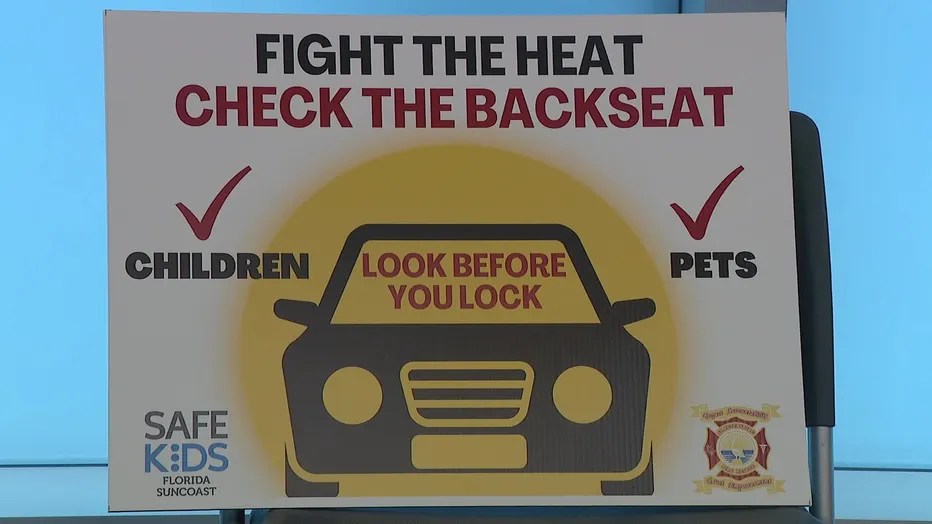
To raise awareness about the deadly risks of leaving children in hot vehicles, Tampa Bay area experts staged a chilling demonstration Thursday using a child-sized mannequin to simulate the effects of heat stroke inside a car.
“Your body can completely cease functioning,” said Dr. Danielle Mercurio, an emergency physician at Johns Hopkins All Children’s Hospital. “Once the brain is deprived of blood and oxygen, it shuts down.”
The event, held by St. Petersburg Fire Rescue and the Safe Kids Florida Suncoast Coalition—led by Johns Hopkins All Children’s—was part of Hot Car Death Prevention Month. It underscored the rapid and dangerous rise in vehicle temperatures, even on mild days.
According to first responders, a car parked on an 80-degree day can heat up by nearly 20 degrees in just 10 minutes.
“Many people mistakenly think cracking a window will prevent the heat buildup—but it doesn’t,” said Dr. Mercurio.
She explained that children can start suffering severe symptoms when their body temperature hits 104 degrees. In a hot parking lot, a car’s interior can soar past 120 degrees.
Since 2020, more than 150 children in the U.S. have died from heat stroke after being left in vehicles—21 of those deaths occurred in Florida. Since records began in 1998, 1,011 children nationwide have died in similar circumstances.
Experts say that in over half of these cases, the child was unintentionally forgotten by a caregiver. About a quarter involved children who entered an unattended car on their own.
“This can happen to any family, in any community,” said Petra Stanton, Injury Prevention Program Manager at Johns Hopkins All Children’s. “Even on cooler days, Florida’s sun can make a car dangerously hot.”
In 2023, 39 children died from hot car incidents in the U.S.—an increase from 29 the year before. One of those tragedies occurred in St. Petersburg, where a one-year-old died in November after the child’s father forgot to drop him off at daycare due to a change in routine.
“People think, ‘I’d never forget my child,’ but our brains can easily skip steps when our routines are disrupted,” said Stanton.
To help prevent such tragedies, St. Petersburg Fire Rescue and Safe Kids urge caregivers to adopt simple habits—like placing a personal item (a shoe, phone, or bag) in the back seat as a reminder, and checking the back seat every time before locking up.
“Preventable injuries are the hardest to bear,” said Dr. Mercurio. “Do whatever it takes. There’s no going back once it happens.”
They also recommend creating backup systems, like asking your daycare to call you if your child doesn’t arrive.
Follow the St. Pete-Clearwater Sun on Facebook, Instagram, Threads, Google, & X
(Image credit: Kids Safe Florida Suncoast)
PIE-Sun.com: local St. Pete-Clearwater news




 St. Pete-Clearwater Sun
Leave a comment