
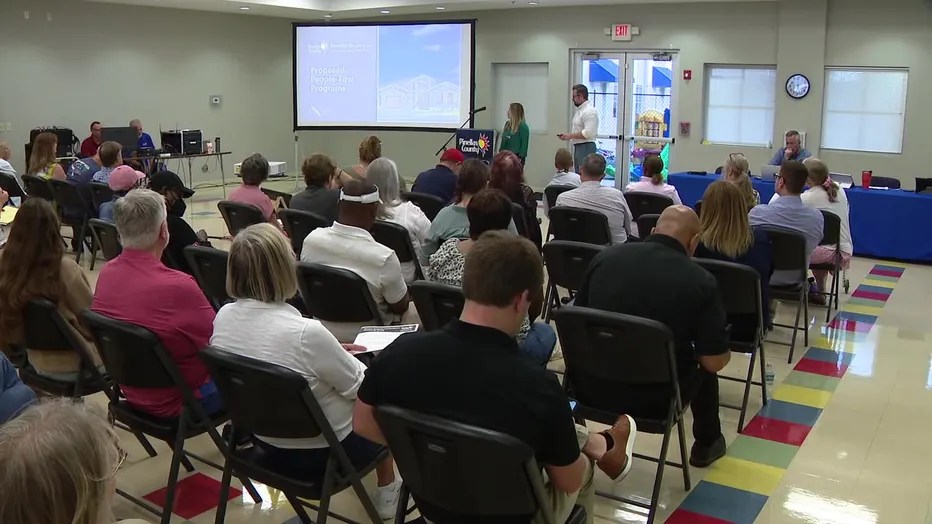
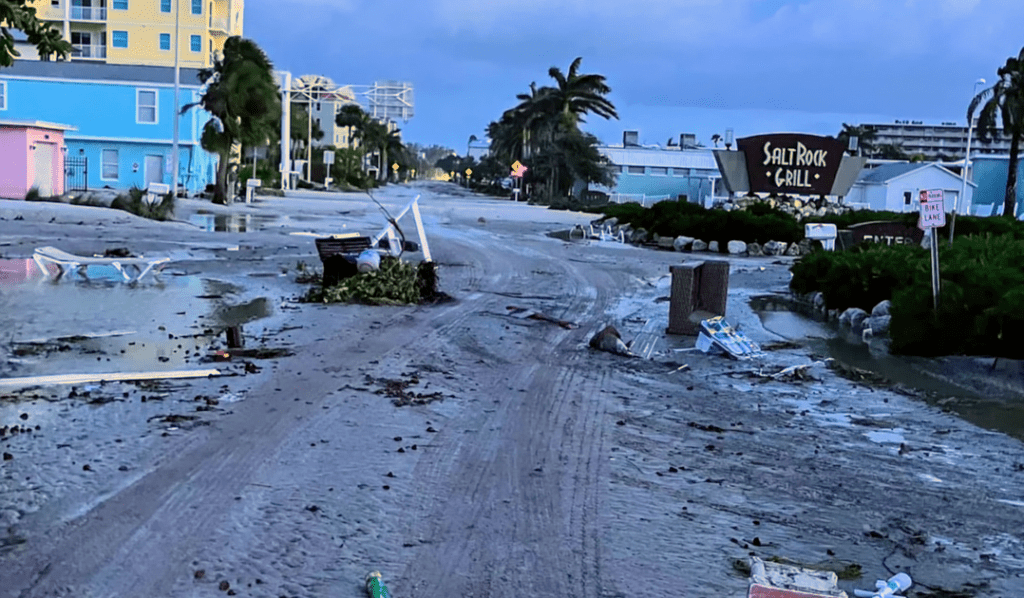
On Monday, Pinellas County residents had their first opportunity to share their priorities for over $800 million in federal hurricane recovery funds during a public meeting. More than 50 people gathered at the Lealman Exchange to discuss the $813 million allocation from the U.S. Department of Housing and Urban Development (HUD), aimed at supporting recovery efforts following Hurricanes Idalia, Helene, and Milton.
Roger Kazanowski, a Pass-a-Grille resident, emphasized the need to prioritize businesses. “So many businesses are completely gone—people’s life savings,” he said, reflecting on his own experience as a small business owner. “Seeing that happen to people is just devastating,” he told Bay News 9.
Gulfport City Councilmember Marlene Shaw echoed the sentiment, advocating for support to help residents return to their homes and businesses. “We need to focus on getting everyone back into their homes and their businesses up and running,” she said.
Pinellas Board of County Commissioners Chair Brian Scott explained that the funds are intended to address unmet needs, with 70% designated for low-to-moderate-income households and areas. “The back-to-back hurricanes six months ago were unprecedented for Pinellas County,” Scott said. “These listening sessions are crucial for understanding the community’s needs.”
A presentation at the meeting highlighted housing as the most pressing need, followed by economic recovery, infrastructure, and public services. Proposed programs include $500 million for home rehabilitation and reconstruction, $57 million for rental property repairs for local landlords, and $32 million for disaster relief payments to cover expenses like rent and utilities. Additionally, $32 million is earmarked for small businesses and nonprofits, and $105 million is set aside for infrastructure mitigation projects.
Scott noted that the first programs are expected to launch this fall, but the process will take time. “This recovery effort will likely span several years,” he said, referencing the county’s experience with the $189 million in ARPA funds from the COVID-19 pandemic, which took years to fully distribute. He urged residents to remain patient as the county works through the process.
The proposed budgets may be adjusted based on public feedback, and income requirements will likely apply to some programs, given the focus on low-to-moderate-income households. The county plans to release a draft action plan in the coming weeks with more details.
Three additional community meetings are scheduled, with the next one set for Thursday, April 10, from 6-8 p.m. at Dunedin City Hall. Residents can also provide input through an online survey at https://recover.pinellas.gov/.
Follow the St. Pete-Clearwater Sun on Facebook, Instagram, Threads, Google, & X
(Image credit: WTVT)
PIE-Sun.com: local St. Pete-Clearwater news

 St. Pete-Clearwater Sun
Leave a comment