
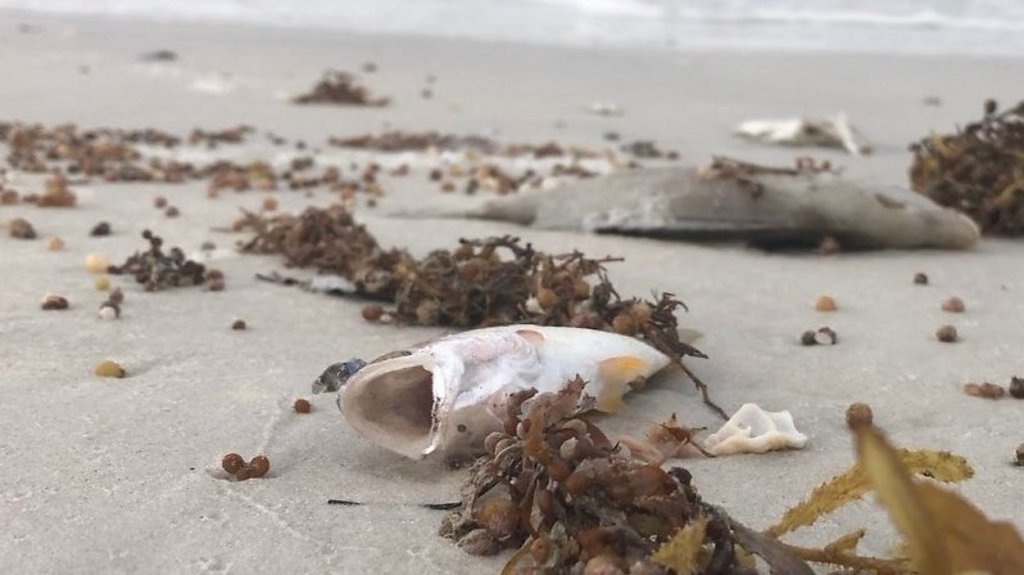
Researchers at the University of South Florida’s St. Petersburg campus have made a historic discovery—the first to identify viruses within red tide blooms.
Their groundbreaking findings could offer new ways to predict and control red tide, which, while naturally occurring, wreaks havoc on coastal economies, devastates marine life with fish kills and more, and triggers respiratory problems in humans.
Scientists from USF’s College of Marine Science (CMS) analyzed water samples collected off Southwest Florida’s coast and discovered multiple viruses—including a previously unknown species—inside Karenia brevis, the single-celled organism responsible for red tide blooms.
“Viruses are highly specific and only infect their usual hosts,” explained Makenzie Kerr, a study co-author. “That means we may be able to use them to target and eliminate Karenia brevis cells during a bloom without harming humans.”
Kerr emphasized that while the presence of viruses in red tide wasn’t unexpected, the fact that no one had identified them before was surprising.
Viruses exist in nearly all living organisms, and Kerr, who manages the Dr. Mya Breitbart Lab, pointed out that they are already used as health tools in other contexts. She reassured that the viruses found in red tide appear to infect only Karenia brevis and pose no risk to humans or marine animals.
Red tide remains a complex phenomenon influenced by environmental factors such as nutrient levels, temperature, ocean currents, and salinity. Yet predicting when and where blooms will emerge, peak, and dissipate remains a major challenge. Kerr noted that understanding every component of a bloom is critical for creating accurate forecasting models.
Current monitoring methods rely on satellite imagery, underwater gliders, and traditional field sampling. The presence of a high viral concentration in a bloom could indicate an imminent outbreak or that a bloom has recently collapsed due to viral infection. “If Karenia brevis dies off, viral levels might spike,” Kerr said. “There’s still much more to uncover.”
Because viruses selectively target specific organisms, they could offer an environmentally safe way to curb red tide blooms. Researchers envision introducing a naturally occurring virus to infected waters to reduce Karenia brevis populations. However, Kerr acknowledged that such an approach would require extensive research and development.
“Studying red tide takes time, tools, and funding,” she said. “But we’re committed to pushing forward.”
The study, recently published in mSphere, a journal of the American Society for Microbiology, underscores St. Petersburg’s role as a hub for marine research. Led by first author Jean Lim, the USF team used metagenomics, a technique pioneered over 20 years ago by senior study author Dr. Mya Breitbart, to extract genetic material from water samples and identify viruses linked to red tide.
Scientists at the Florida Fish and Wildlife Conservation Commission’s (FWC) Research Institute, located near the CMS, contributed by collecting samples and collaborating with the USF researchers. “Not every lab has the capability or interest to study red tide,” Kerr said, highlighting the importance of local expertise.
Moving forward, the team plans to study how different viral loads affect Karenia brevis in controlled lab settings. Kerr said this phase of research will likely yield unexpected discoveries. They also aim to cultivate the virus in the lab and continue searching for other viruses associated with red tide.
While using viruses to combat red tide blooms is an ambitious and long-term goal, Kerr remains optimistic. “That’s what we’re working toward,” she told the Catalyst.
She encouraged local residents to do their part by avoiding summer fertilizer use, as nutrient runoff can fuel red tide growth. She also reminded people that not all microscopic algae are harmful—many play a crucial role in producing Earth’s oxygen supply.
“It’s not all bad,” she said. “There are a lot of good guys too.”
Follow the St. Pete-Clearwater Sun on Facebook, Instagram, Threads, Google, & X
(Image credit: Spectrum News)
PIE-Sun.com: local St. Pete-Clearwater news


 St. Pete-Clearwater Sun
Leave a comment