
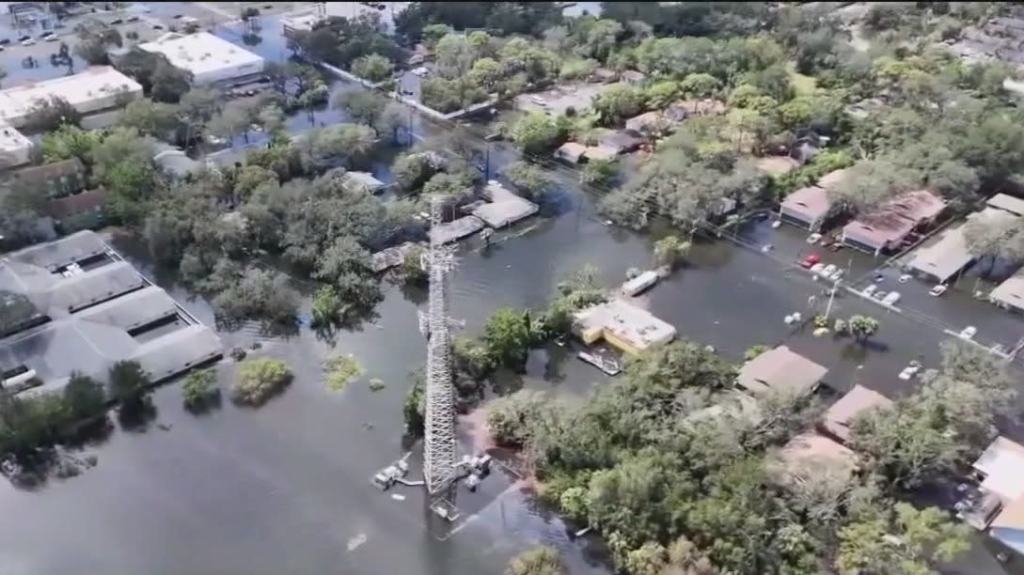
Hurricane victims in Tampa are grappling with confusion over who qualifies for relief funds and when they might receive assistance, prompting city leaders to call for patience. Recently, some homeowners received emails informing them that they won’t be getting financial help in the immediate phase.
Marilyn Menendez-Arnett, whose husband Wendal passed away in June 2023, has been struggling since her home flooded during Hurricane Milton in October. “I had this home with my husband who just died, and now I have nothing—I was barely able to save his ashes,” she shared with WFLA. Arnett, now facing financial hardship, applied for Tampa’s Homeowner Disaster Assistance Program.
Abbye Feeley, Tampa’s Development and Economic Opportunity Administrator, explained that the program is funded with $3.2 million from state housing funds. “The city didn’t have dedicated hurricane recovery funds,” Feeley said. “We identified eligible federal and state grant funds to support this effort.” She added, “We weren’t entirely sure how this would work, but we knew the funds had to target specific income levels, and that’s how we’ve begun.”
The city’s eligibility criteria are based on income levels, with a chart specifying percentages. According to the city’s website, residents must fall within the 140% income category to qualify. Arnett and many neighbors in Forest Hills, including Sherri Allen, believe they meet this threshold. However, Allen was stunned by an email she received on Monday. “The email said I wasn’t eligible for the first phase and that I’d get a link to complete my application only if there’s money left over after that phase,” Allen told WFLA.
Currently, the first phase prioritizes applicants in the 30% and below income category, which, for a one-person household, means an annual income of $20,100 or less. Both Arnett and Allen told WFLA they felt blindsided by the city’s communication. “I’m just devastated,” Arnett said. “I still need to replace furniture for three bedrooms, a living room, appliances—everything.”
City leaders, however, maintain they’ve been transparent about the process, explaining that the funds must be distributed in phases due to their source. “We have to prioritize our set-asides first,” Feeley clarified. “We can’t risk allocating funds to a higher income group and then failing to meet the set-aside requirements of the $3.2 million.”
Follow the St. Pete-Clearwater Sun on Facebook, Instagram, Threads, Google, & X
(Image credit: WTVT/Yahoo News)
PIE-Sun.com: local St. Pete-Clearwater news

 St. Pete-Clearwater Sun
Leave a comment