

Heather Wendt’s father-in-law built their two-story home in Crystal Beach, Pinellas County, over 50 years ago. Despite being situated along Sutherland Bayou, floodwaters had never reached the doorstep—until last year.
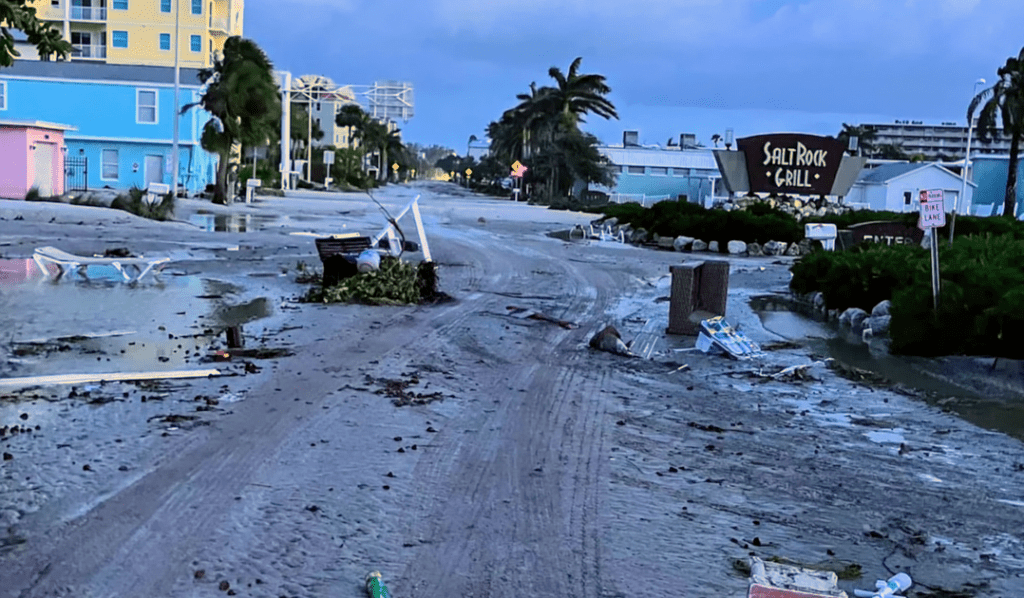
Now, the blue carpet that once lined her staircase is torn from the first three steps, and remnants of spray-foam sealant cling to the front door. Hurricane Helene’s floodwaters seeped in through her garage air handler, rising up to a foot deep inside.
Though she has continued living in the home and working remotely from the second floor, she was stunned to receive a letter from Pinellas County in November, declaring her home “substantially damaged.” Even more surprising—no one had inspected the house before making this determination.
“We were kind of shocked and thrown back with that, especially since nobody had actually come in and inspected the house whatsoever,” she told the Tampa Bay Times. “That was the first initial, ‘Woo, what the heck happened?’”
Across Tampa Bay, at least 10,000 property owners have received or are set to receive similar letters, according to a Tampa Bay Times survey of local municipalities. These letters, based on assessments by hired private firms, determine whether a home or business has sustained damage exceeding 50% of its value. If so, property owners face three choices: elevate the building, relocate it, or demolish it. If they opt for demolition, they may rebuild higher or move elsewhere.
For many, the financial burden is immense—tens of thousands of dollars in additional recovery costs, on top of insurance deductibles.
Why Are These Letters Being Sent?
Local governments must assess damage accurately to maintain flood insurance discounts for residents. St. Petersburg residents receive a 25% discount, while unincorporated Pinellas County homeowners save 40%. Florida’s participation in the National Flood Insurance Program mandates that properties determined to be substantially damaged must meet updated federal flood standards, often requiring elevation or complete rebuilding.
Homeowners can request reassessments if they disagree with the determination. In unincorporated Pinellas, this process is free, and residents may also hire private appraisers. However, assessment methods vary. Some jurisdictions, like Pinellas, send letters stating a final determination, while others notify residents that an assessment is needed before issuing a damage estimate.
Disputed Assessments
Many homeowners claim the assessments are flawed and lack transparency. Public officials acknowledge that inspectors often rely on external evaluations rather than entering homes, basing their determinations on visible floodwater marks. Pinellas County used private contractors from Tidal Basin, while Hillsborough County hired Tetra Tech. A Tidal Basin spokesperson stated that its role is to collect damage estimates under the direction of local governments, which ultimately decide who receives letters.
Homeowners, however, argue that such assessments are insufficient grounds for potentially forcing them out of their homes. At a Pinellas County Commission meeting in December, Crystal Beach resident John Richter voiced his frustration:
“They are screwing people’s lives up,” he told the Tampa Bay Times. “Who are these people that can come out and tell me I could lose my house unless I jump through these hoops?”
Fighting to Keep Their Homes
Some residents, like Wendt, have successfully overturned their damage assessments. After attending a County Commission meeting, she secured approval to repair her family’s longtime home. “If they had done an actual inspection,” she said, “we probably would’ve been through this a lot faster and without such heartache.”
Others, like Lance Fox, are still fighting. Fox’s elderly mother received her letter just before Christmas, stating that her Indian Bluff Island home—where she has lived since 1980—was substantially damaged. Yet, no one ever stepped inside. Months later, they were still awaiting a reassessment.
For Jackie McCall of St. Pete Beach, the battle was especially personal. After Hurricane Helene, she spent days removing debris from her 1930s wood-framed home, only to receive a letter stating it would need to be elevated or rebuilt.
“It seems really inhumane,” she said. “Going through that kind of tragedy and then having to deal with all this red tape… it’s exhausting and scary.”
She eventually hired a private appraiser, who determined her home’s damage was 33.5%, not the government’s estimated 53.1%. With this evidence, she overturned the decision. Still, the experience has left her reconsidering whether she wants to stay.
“These letters are faulty, I think everybody knows that,” she said. “I wasn’t going to let them take my house.”
Government Consequences and the Road Ahead
Accurate assessments are crucial for local governments to comply with federal flood insurance requirements. Failure to do so can lead to penalties, as seen in Lee County, which temporarily lost its 25% flood insurance discount due to inadequate assessments.
In Hillsborough County, officials have estimated 3,700 properties may be substantially damaged, but letters hadn’t yet been sent as of early March—nearly five months after the hurricanes. “It’s a marathon, not a sprint,” said Hillsborough Floodplain Administrator Kyle Dollman.
For homeowners like Wendt, the struggle isn’t over. Though she managed to challenge her assessment, she still worries about rising flood insurance costs and future storms. Her home, once a family paradise, now feels different.
Standing in her living room, surrounded by tubs of salvaged belongings, she reflected:
“It doesn’t feel like a happy paradise anymore.”
Follow the St. Pete-Clearwater Sun on Facebook, Instagram, Threads, Google, & X
(Image credit: Dirk Shadd/Tampa Bay Times)
PIE-Sun.com: local St. Pete-Clearwater news

 St. Pete-Clearwater Sun
Leave a comment