
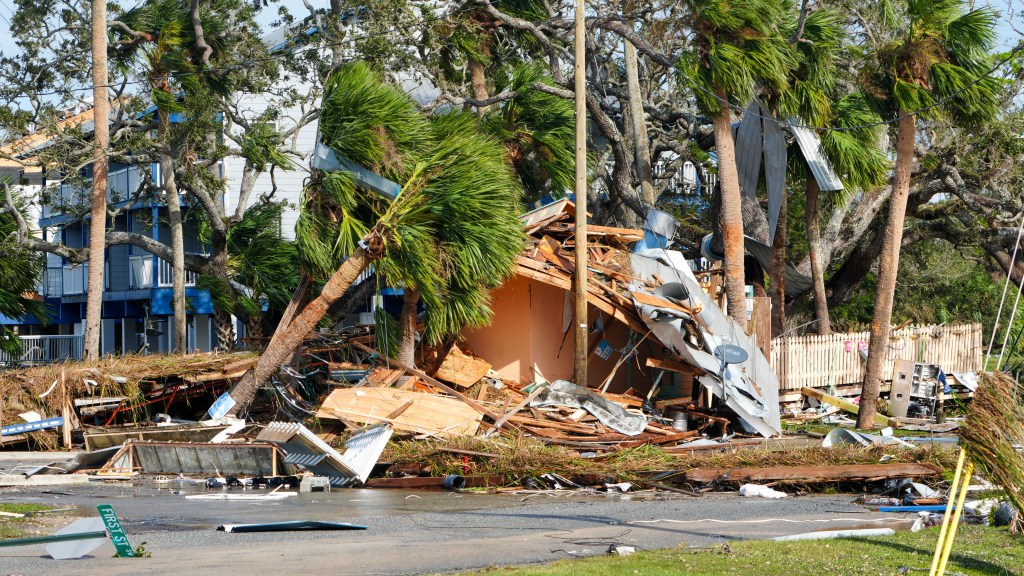
City Council members recently convened with consultants to ensure St. Petersburg meets federal requirements to secure $160 million in disaster recovery funding.
The city must allocate $139 million to unmet storm recovery needs and $20.85 million to mitigation efforts, with at least 70% of the funds benefiting low-to-moderate-income (LMI) households.
To assist in developing the required action plan, officials selected Horne, a professional services firm, through a competitive process. At a March 13 Committee of the Whole meeting, Council members received an overview of fund usage, program timelines, and potential presidential policy changes.
“I want people to be left with a message of hope,” said Councilmember Brandi Gabbard. “We’re doing everything we can to build better and become more resilient. This is just one of many opportunities to achieve that.”
The funding originates from the U.S. Department of Housing and Urban Development’s (HUD) Community Development Block Grant-Disaster Recovery (CDBG-DR) program. City officials will distribute the money through the newly launched Sunrise St. Pete initiative.
Congress allocates CDBG-DR funds to aid disaster-impacted areas and support long-term recovery. While the funding can support a broad range of efforts, local governments must submit an action plan aligning with federal guidelines.
Ryan Flanery, a program expert with Horne, noted that rules frequently change but consistently prioritize LMI households and eligible activities. However, he highlighted a recent shift as the new presidential administration rescinded a universal notice issued in January. “They’re removing much of the language associated with the president’s executive orders and other policies,” he said.
Horne is now collecting public feedback to determine the “highest and best use” of the funding. This, along with an unmet needs assessment, forms the first step in creating a federally approved action plan.
Despite the sizable sum, Flanery acknowledged that $160 million is insufficient to address all of the city’s unmet needs. Efficiency remains a priority as officials develop their spending strategy.
Once completed, the plan will be posted for public comment before submission to HUD, which has 45 days to review and impose any additional conditions.
“We have good connections in the administration and at HUD,” Flanery said. “We don’t anticipate any major surprises in the grant agreement.”
The city must allocate approximately $112 million (70% of the funds) to households earning 80% or less of the area median income (AMI), around $74,000 for a family of four. Up to $8 million can cover administrative costs, while the remainder supports eligible activities, including housing, infrastructure, economic development, hazard mitigation, and public services.
Unmet needs include recovery efforts not covered by the Federal Emergency Management Agency (FEMA), Small Business Administration (SBA), and National Flood Insurance Program (NFIP). The city expects to submit its action plan to HUD in July and receive a grant agreement in the fall.
“That is extremely fast for HUD,” Flanery remarked. “This rapid turnaround presents unique opportunities since we’re still in recovery with FEMA funding.”
Flanery suggested the funds could help elevate homes, though many residents undertaking that work earn above the 80% AMI threshold. Workforce development training for home elevation projects is another potential use of the funds, with officials having six years to allocate the money. Gabbard emphasized the long-term benefits of developing a local contractor workforce.
Councilmember Gina Driscoll voiced concerns about discussing program details while awaiting guidance from the presidential administration. She cited Tampa’s recent loss of a $1.6 million grant intended for tree planting in a low-income area.
Flanery noted that Horne received an advanced draft of HUD’s revised universal notice. “We see the removal of language related to vulnerable populations and protected classes,” he said. However, the 70% LMI requirement remains unchanged, which he found noteworthy. He added that HUD might now be more open to waivers on income restrictions.
Amy Foster, the city’s housing and neighborhood services director, acknowledged Driscoll’s concerns, noting that Asheville, North Carolina’s action plan was recently rejected for emphasizing small and minority-owned businesses. Foster agreed that prioritizing citywide housing and infrastructure initiatives is critical.
Driscoll cautioned stakeholders to manage expectations. “There’s a lot we can do, but there are limits.”
A community survey for public input will launch on the Sunshine St. Pete website on March 24. Driscoll stressed the importance of phrasing survey questions to help residents reflect on their needs before, during, and after storms. She noted that while affordable housing is a recurring concern, some residents may prioritize practical disaster-related improvements, such as functional sanitation systems during hurricanes.
Residents can also share feedback on Sunrise St. Pete at Mayor Ken Welch’s first City Hall on Tour event of 2025. The event will take place at The Coliseum on March 26, from 5:30 to 7:30 p.m.
Follow the St. Pete-Clearwater Sun on Facebook, Instagram, Threads, Google, & X
(Image credit: Florida Today)
PIE-Sun.com: local St. Pete-Clearwater news


 St. Pete-Clearwater Sun
Leave a comment