
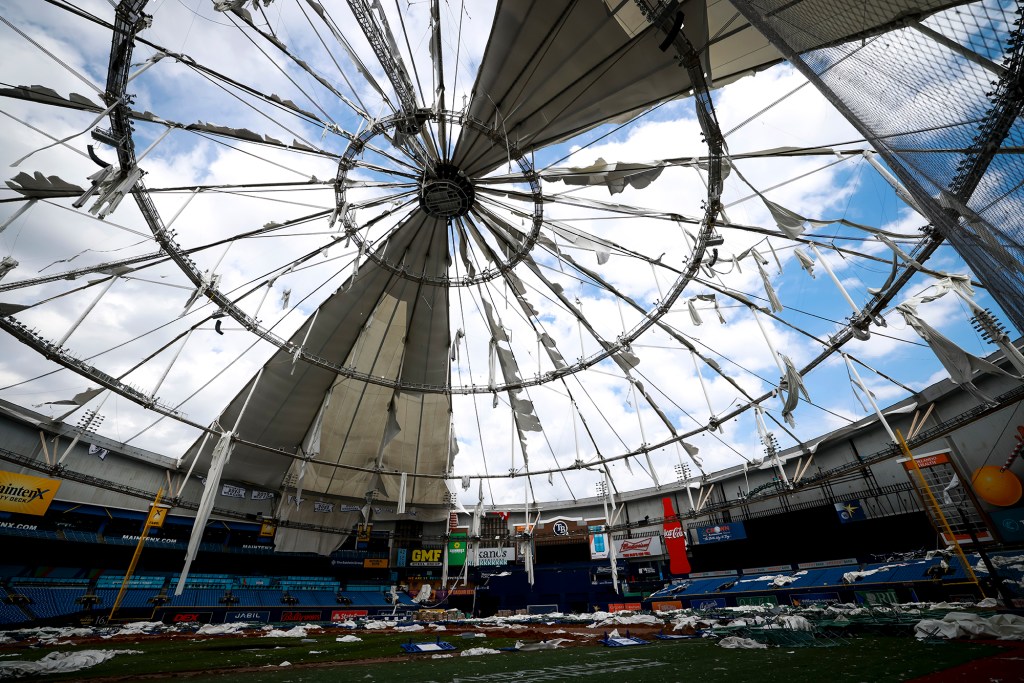
St. Petersburg officials are standing by their decision to reduce insurance coverage on Tropicana Field, despite facing widespread criticism after Hurricane Milton severely damaged the stadium’s roof just months later.
The aging ballpark remains the city’s most expensive asset, with St. Petersburg set to spend roughly $56 million on repairs while uncertainty looms over its planned demolition and the future of the Tampa Bay Rays.
Since October 9, 2024, the once-enclosed stadium has remained exposed, with the next hurricane season less than three months away. However, the city won’t increase its insurance coverage until 2026.
At a March 13 Budget, Finance, and Taxation (BFT) Committee meeting, Risk Manager Blaise Mazzola defended the current $25 million claim limit, stating that it remains adequate. He explained that a contractor would provide supplemental coverage while repairing the dome.
“We will be looking in April 2026 to enhance coverage to $50 million or another amount, depending on modeling,” Mazzola said. “But this year, based on the multiple layers of coverage between the contractor and the city, we believe the $25 million limit is still appropriate.”
A Cost-Saving Decision
Insurers have long considered Tropicana Field’s dome a liability. In March 2023, city documents revealed that its aging roof and lack of historical loss data made insurers hesitant to provide coverage.
Until March 2024, St. Pete maintained a $100 million wind and flood damage policy. Reducing that coverage to $25 million saved the city $275,000 annually. Mazzola described the move as “palatable,” emphasizing that the decision was based on a “very educated estimation.”
Despite its depreciation, Tropicana Field remains valued at nearly $449 million. Tony Leavine, executive vice president of Brown & Brown Insurance, noted that such a high single-structure value increases the program’s potential maximum loss.
Repair Costs and Future Outlook
The city will spend an estimated $24 million repairing the stadium’s roof, with a $22.5 million deductible. This means the maximum insurance payout the city could receive is $22 million. Officials also anticipate Federal Emergency Management Agency (FEMA) funding.
Mazzola highlighted the potential benefits, stating the city could receive replacement costs for the new dome, which is expected to be installed by late November or December—after hurricane season ends. He downplayed the risk of another major windstorm causing additional damage before then.
While some officials have questioned investing more money into the deteriorating stadium, others see the repairs as necessary. Councilmember Gina Driscoll previously stated she did not want to spend beyond what the city’s use agreement with the Rays requires.
The Uncertain Future of Tropicana Field
The Rays were originally responsible for securing and maintaining a new stadium in St. Petersburg, but team owner Stuart Sternberg recently abandoned those plans. The team proposed improving Tropicana Field and extending its lease through 2038, but negotiations have stalled.
Meanwhile, St. Petersburg suffered between $28 billion and $47 billion in insured losses from Hurricanes Helene and Milton. With its property insurance set to renew on April 1, the city must decide how to navigate future coverage and financial risks.
Follow the St. Pete-Clearwater Sun on Facebook, Instagram, Threads, Google, & X
(Image credit: Will Vragovic/Tampa Bay Rays)
PIE-Sun.com: local St. Pete-Clearwater news
 St. Pete-Clearwater Sun
Leave a comment