
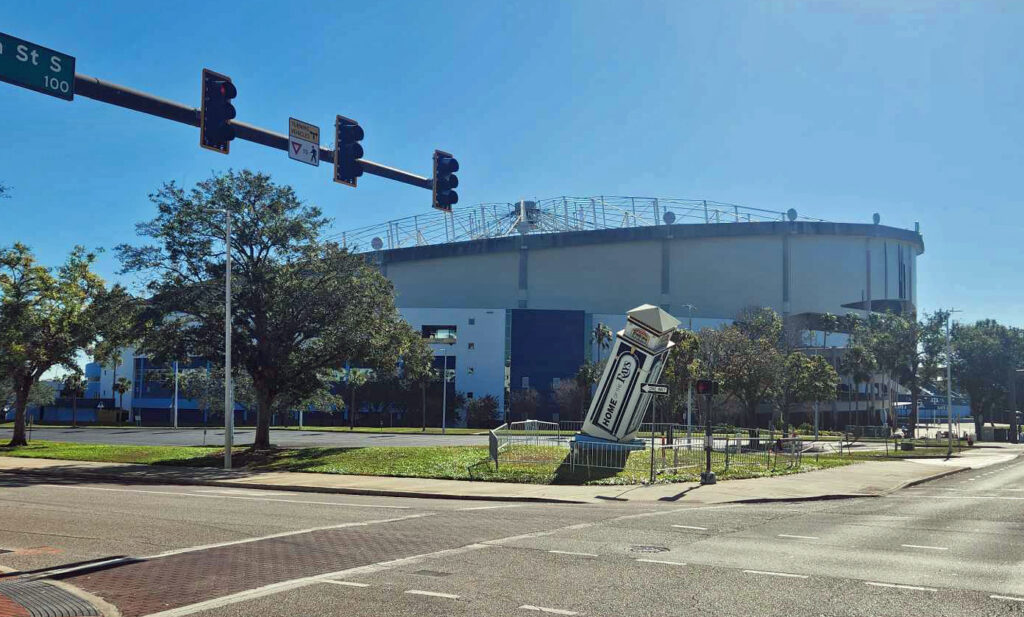
What seemed like a negotiating tactic has become a reality: the Tampa Bay Rays have abandoned a $1.37 billion stadium deal in downtown St. Petersburg after years of talks.
The team’s partner, Hines, has scrapped plans to convert Tropicana Field’s sprawling lots into a lively mixed-use area honoring the displaced Black community. Still, Rays owner Stuart Sternberg hinted at a slim chance for a revised deal.
On Thursday, team officials told St. Petersburg and Pinellas County leaders they wouldn’t meet key project deadlines by March 31, though no official termination notice was sent. Sternberg told the St. Pete Catalyst he’d made the call “very recently” after fruitless talks with local stakeholders.
“After much thought, we’ve decided we can’t proceed with the new ballpark and development right now,” Sternberg said in a statement. “Unforeseeable events since October forced this tough choice.”
Negotiations and approvals had stayed on course for a 2028 opening of a new ballpark anchoring the $6.7 billion Historic Gas Plant District—until Hurricanes Helene and Milton struck in 2024. Milton tore through Tropicana Field’s roof, racking up $55 million in damages.
A critical county bond vote was pushed back seven weeks in October. Delays, lost income, rising construction costs, and new steel tariffs have tacked on hundreds of millions to the Rays’ tab—costs Sternberg can’t offset with the team’s low attendance, despite its strong on-field record.
“We were pushing hard to do something great for St. Pete, a city we care about,” said Rays president Brian Auld. “But the world shifted—two hurricanes, local and national elections—everything’s been upended. It’s not shocking this fell through too.”
St. Petersburg had agreed to sell 65 acres to the Rays and Hines at a bargain, chip in $287.5 million for the stadium, and add $130 million for infrastructure. Pinellas County pledged $312.5 million from tourism taxes for a 30,000-seat, multi-use ballpark. The Rays were set to cover $700 million-plus, handle overruns, and fund $50 million in community benefits—but local leaders wouldn’t help close the financial gap.
Sternberg stressed trust as vital to the partnership, a bond now visibly frayed, especially with some county commissioners. Though skeptical, he’d “absolutely” hear out new ideas. “We’ve always aimed to keep the team in Tampa Bay,” he said.
Auld noted city and county officials seem uninterested in tweaking the original plan. Without the Rays, the city might develop the Trop site solo, likely yielding a disjointed sprawl of condos.
“Our dedication to the Rays’ future remains firm,” Sternberg said. “We’re focused on a ballpark solution that works for our region, MLB, and our team.”
Sternberg dodged questions on potential buyers or MLB pressure to sell, saying only that the league knows of his decision. Time, at least, is on their side. He thanked St. Pete for its “huge effort” in talks and for plans to fix the Trop by 2026.
“Having a local spot to play for four more seasons is a win for us,” Auld said. “We’ll field a strong team and keep fans happy while we figure this out.”
The city could upgrade the Trop, extend the Rays’ lease a decade, and kick off the Gas Plant project. But Mayor Ken Welch has signaled a new deal with the Rays is unlikely.
“Some groundwork could be adapted to avoid a total restart,” Auld said. “The frustration is no one’s discussing it.”
Follow the St. Pete-Clearwater Sun on Facebook, Instagram, Threads, Google, & X
(Image credit: Bill DeYoung)
PIE-Sun.com: local St. Pete-Clearwater news

 St. Pete-Clearwater Sun
Leave a comment