
A legal battle over the presidential administration’s pause and review of federal funding has created uncertainty for the City of St. Petersburg at a critical time.
City officials are awaiting approximately $200 million from the Federal Emergency Management Agency (FEMA) and an additional $160 million in hurricane recovery funds for residents. Frustrated city council members voiced their concerns to lobbyists during a Feb. 20 legislative committee meeting.
In response, administrators are revising the city’s federal legislative agenda to align with the new administration’s policies. Robert Diamond, a municipal lobbyist with Washington, D.C.-based Capitol Counsel, warned that proposed FEMA cuts could significantly impact disaster recovery efforts.
“I can’t overstate how serious these changes are,” Diamond said. “The administration has taken a sledgehammer approach in its first 30 days, leading to significant unintended consequences.”
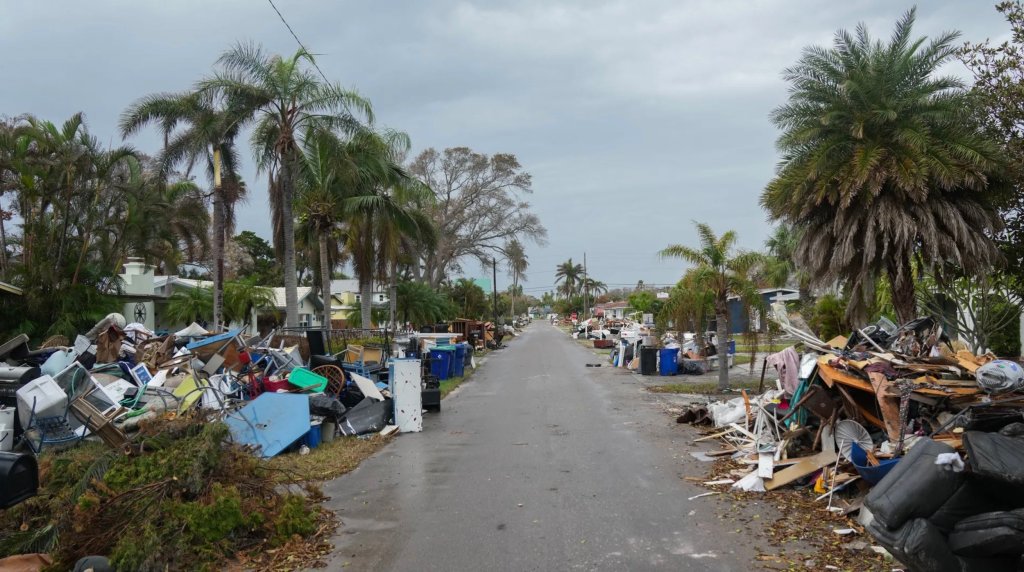
Pinellas County sustained approximately $2.5 billion in damage from Hurricanes Debby, Helene, and Milton, with St. Petersburg alone incurring at least $247.3 million in costs to city-owned properties. Officials expect FEMA reimbursements to cover all but $14 million. Mayor Ken Welch has previously stated that federal funding and insurance payouts for Tropicana Field have influenced his decision to repair the storm-damaged stadium rather than offering the Tampa Bay Rays a cash settlement.
However, those plans are now in limbo. Diamond explained that an executive order effectively froze funding across all federal agencies, a move that was promptly challenged in court.
“We are just in the first inning of what will be a constitutional battle,” he said. “This is a significant separation-of-powers issue.”
The funding freeze impacts not just disaster relief but also public programs, academic research, and private sector initiatives. “We’re talking about hundreds of billions—if not trillions—of dollars,” Diamond added.
Councilmember Lisset Hanewicz expressed concern over the fate of previously signed agreements with federal agencies, noting that the administration’s first month has already felt like a lifetime.
On Jan. 7, the former administration announced that St. Petersburg would receive $160 million through the U.S. Department of Housing and Urban Development’s (HUD) Community Block Grant – Disaster Recovery program. Pinellas County is set to receive $813.8 million through the initiative, which aims to rebuild affordable housing, strengthen infrastructure, and support small businesses.
While Diamond reassured council members that congressionally authorized funding “should be safe,” he noted that the administration is waiting for new appointees to oversee federal agencies before resuming the disbursement process.
“They’re not saying they’ll defund or claw it back,” Diamond explained. “But best-case scenario, there will still be delays as this moves through the courts.”
Hanewicz also pointed out that St. Petersburg is still awaiting a $3 million FEMA reimbursement from 2022. She and other council members acknowledged that ongoing uncertainty will impact budgetary and policy decisions.
Further complicating the city’s financial challenges are rising tariffs. Hanewicz noted that officials already lack sufficient funds to complete planned infrastructure projects, and a 25% increase in construction material costs will only make matters worse.
“People need to understand what a tariff is—it’s an additional tax that will ultimately be passed down to us,” she said.
St. Petersburg’s federal legislative agenda prioritizes environmental resilience and equitable development funding. However, Councilmember Brandi Gabbard warned that the term “equitable” could be politically contentious and should be revised to avoid unnecessary pushback.
She emphasized the need to adjust language strategically when discussing legislative priorities. Her colleagues agreed that securing essential federal funding should take precedence over making political statements.
“In an environment where everything is being cut dramatically, it’s tough to advocate for program expansions and new legislation,” Diamond cautioned. “We need to be realistic about that.”
Councilmember Deborah Figgs-Sanders suggested refining the legislative agenda’s language without fundamentally altering its goals. The current draft states that federal funding, trade policy, and agency changes will place undue burdens on residents and businesses. It also calls for “thoughtful and humane” immigration reform.
To improve the agenda’s alignment with the administration’s priorities, the committee approved a resolution for Diamond to assist in redrafting the document. The city council will review the revisions on March 6, ahead of a scheduled visit to the nation’s capital by local stakeholders.
“I don’t think we’ve been afraid to make our stance known through resolutions,” said Council Chair Copley Gerdes. “I’m willing to pick a fight—I’m just not sure this is the one to pick.”
Follow the St. Pete-Clearwater Sun on Facebook, Instagram, Threads, Google, & X
(Image credit: Bryan R. Smith/Getty Images)
PIE-Sun.com: local St. Pete-Clearwater news



 St. Pete-Clearwater Sun
Leave a comment