
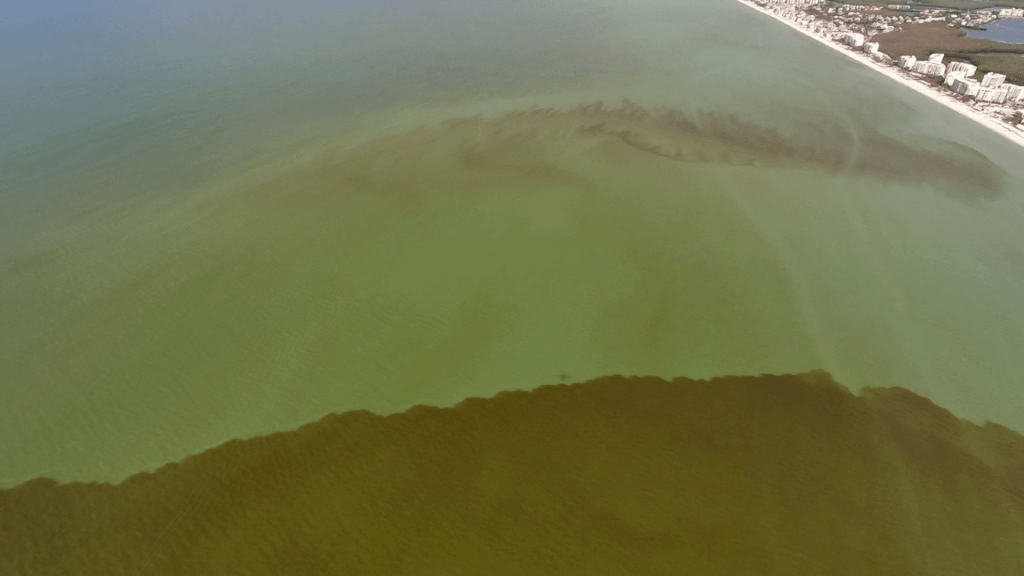
A massive red tide bloom, stretching over 200 miles from Tampa Bay to Key West, has moved ashore along much of Southwest Florida’s coastline.
The concentration of Karenia brevis, the organism responsible for red tide, varies across the region—weak in some areas but dense enough in others to stain the blue-green waters a burnt orange for miles.
The bloom first appeared near Tampa Bay shortly after Hurricane Milton in October and has been visible in satellite imagery for months. Now, its epicenter is focused around Lee and Charlotte counties, including Sanibel and Captiva islands.
Pollution and Nutrient Runoff Fueling the Bloom
David Tomasko, director of the Sarasota Bay Estuary Program with over 30 years of experience in coastal science and water quality, has linked extended red tide blooms to excess nitrogen in Florida’s waters. According to Tomasko, the source of the problem lies 75 miles inland.
For over two months, the Army Corps of Engineers has been releasing millions of gallons of nutrient-laden water from Lake Okeechobee into the Caloosahatchee River. This water, polluted by decades of fertilizer use from both family farms and large-scale agriculture, eventually flows into the Gulf of Mexico.
“The Army Corps is trying to lower Lake Okeechobee by a couple of feet due to heavy rainfall this past wet season,” Tomasko explained. “In doing so, about 80 billion gallons of water have been discharged into the eastern Gulf.”
While red tide is a naturally occurring phenomenon, the influx of nitrogen-rich water exacerbates and sustains these harmful blooms.
Satellite Images Show Red Tide’s Growth
Hurricane Milton made landfall at Siesta Key nearly four months ago, unleashing torrential rains and washing debris, oil, fertilizers, and other pollutants into the Gulf. Days later, satellite images detected the early signs of red tide developing south of Tampa Bay.
A similar sequence of events occurred after Hurricane Ian in 2022, when storm runoff fueled smaller red tide blooms between Sarasota and Naples. This time, however, the bloom has drifted southward, growing offshore before being pushed toward land by onshore winds.
Marine scientists from various Southwest Florida conservation groups have been collecting water samples to track the bloom’s expansion. As the red tide approached Sanibel and Captiva, it mixed with nutrient-laden runoff from the Caloosahatchee River, intensifying its effects.
Two weeks ago, the Sanibel-Captiva Conservation Foundation (SCCF) began reporting red tide impacts on local beaches. Portions of the bloom have surged inland, bringing respiratory irritation and fish kills to the region.
Health Warnings and Environmental Impact
Health officials have issued warnings for more than a dozen beaches across Southwest Florida, including Turner Beach on Captiva, Bowman’s Beach on Sanibel, and Barefoot Beach State Preserve in Collier County. Elevated red tide toxin levels have also been detected near Marco Island, Naples Bay, and Monroe County’s Marquesas Keys.
Recent samples taken from Lee County beaches indicate fluctuating concentrations of Karenia brevis, though satellite imagery and aerial surveys reveal a substantial bloom stretching from Sanibel to Naples.
Last weekend, SCCF scientists recorded alarmingly high levels—22 million cells per liter—off Algiers Beach and Tarpon Bay Road Beach. For context, red tide concentrations above 1 million cells per liter are considered high.
How Long Will This Red Tide Last?
Historical data suggests red tide events in this region can persist for weeks or even months, especially when fueled by hurricane-driven nutrient upwelling. The ongoing bloom’s duration will depend on factors like nutrient availability, ocean currents, and weather conditions.
Forecast models predict surface waters will move north while deeper waters shift northwest over the next few days, but there’s no immediate sign of the bloom dissipating. A cold front may temporarily ease coastal impacts, yet high chlorophyll concentrations—an indicator of red tide—remain visible offshore from Charlotte to Monroe counties.
The Florida Fish and Wildlife Conservation Commission will release an updated status report on Wednesday, potentially offering new insights into the bloom’s trajectory.
Mark Thompson, a researcher with SCCF, warned that runoff from recent rains has provided additional nutrients to sustain the bloom. “With light onshore winds and calm surf, the red tide has concentrated along the shoreline, increasing the risk of respiratory issues and other adverse effects,” he noted.
As scientists and environmental agencies monitor the situation, residents and visitors are advised to stay informed and heed health advisories for affected beaches.
Follow the St. Pete-Clearwater Sun on Facebook, Instagram, Threads, Google, & X
(Image credit: WINK)



 St. Pete-Clearwater Sun
Leave a comment