
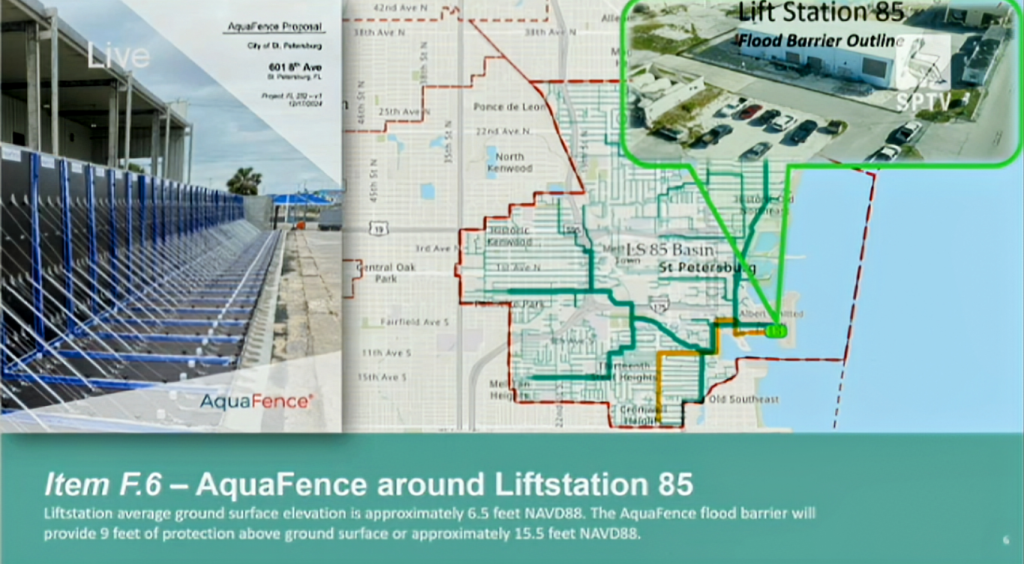
Mayor Ken Welch has emphasized the necessity for agile resilience since consecutive hurricanes wreaked havoc in September and October. St. Petersburg has decided to invest in a deployable flood wall and waterproof sewer infrastructure.
The City Council unanimously endorsed these measures during their Thursday afternoon session. The city aims to have a custom-made AquaFence, an impermeable flood barrier, ready to safeguard a downtown lift station before the onset of hurricane season in June.
The rapidly deployable FloodWall system gained national attention in September when it successfully protected Tampa General Hospital from a seven-foot storm surge during Hurricane Helene. Councilmember Brandi Gabbard expressed her enthusiasm, stating, “Anything we can do that’s creative and an immediate pivot to making us more resilient on these infrastructure items – we’re all for. So, I’m very excited that you brought these today.”
St. Petersburg will acquire 518 linear feet of AquaFence, stored in 20 weather-resistant crates, at a cost of $628,000. Company reps will provide on-site training to the lift station maintenance team to ensure effective deployment and operation.
This barrier will surround Lift Station #85 near Albert Whitted Airport. Public Works Director Claude Tankersley explained that this station collects wastewater from the downtown waterfront and sends it to the Southwest Sewer Treatment Plant. He noted that while the lift station’s base elevation of 6.5 feet was never previously flooded, Hurricane Helene changed that, with Hurricane Milton predicted to bring a 15-foot surge.
Tankersley highlighted that the nine-foot AquaFence, combined with the existing elevation, offers significant protection. He also pointed out the long manufacturing lead times for these barriers, emphasizing the urgency of installation before storm season.
While the possibility of acquiring more AquaFences was discussed, questions arose about prioritizing sewer service downtown. The Northeast and Southwest Sewer Treatment Plants had to be closed during Hurricane Milton to prevent flooding. Tankersley explained the strategic choice due to the smaller footprint of the lift station and the specific installation requirements of the AquaFence.
He further noted the variety of deployable barriers available, aiming for the right application for each scenario. Encircling entire neighborhoods would be prohibitively expensive, so the focus is on protecting critical infrastructure like wastewater facilities.
Building a new lift station would cost over $26 million, making the $618,000 investment in AquaFence a more economical choice, according to Council Chair Copley Gerdes, who commended the creative approach.
Councilmember Lisset Hanewicz underscored the importance of the lift station, serving many critical facilities in downtown, including hospitals.
Additionally, the council approved an increase of $2 million to the contract with Razorback LLC from Tarpon Springs. This will fund the application of waterproofing compounds to exposed pipes and tanks, a process known as “dry flood-proofing,” which Tankersley described as a method to extend service life and protect against quick-dissipating storm surges.
He elaborated that this waterproofing would be applied to vulnerable water infrastructure temporarily, until more permanent solutions like elevating facilities could be implemented. Various equipment at the Northwest and Southwest Sewer Treatment Plants will receive these coatings as part of interim resilience measures.
Follow the St. Pete-Clearwater Sun on Facebook, Instagram, Threads, Google, & X
(Image credit: Aquafence)


 St. Pete-Clearwater Sun
Leave a comment