
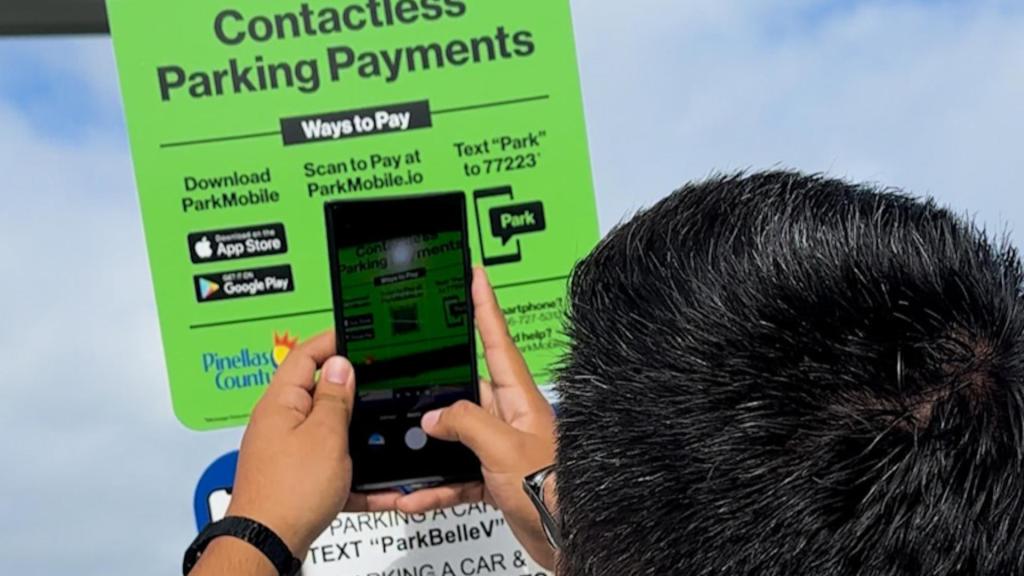
Law enforcement officials are cautioning the public about a new scam involving fake QR code stickers on parking payment signs.
Parking in downtown St. Pete, Tampa, or any of our beautiful beaches can be challenging. Parking apps and online payment options have eased the process once you find a spot. Many signs provide a QR code that can be scanned to direct you to the app or website for payment.
However, law enforcement urges you to think twice before scanning these QR codes, as scammers may have placed fake stickers over the real ones.
The Pinellas County Sheriff’s Office highlighted that with every technological advancement meant to simplify our lives, scammers find new ways to exploit these tools to steal your information.
“Whether you’re an Android or an Apple user, all you have to do is point your camera at a QR code, and you’ll be guided wherever they want you to go,” said the sheriff’s office. “This can be very convenient, but it is also a way for scammers to set the perfect trap.”
Just as you would be wary of clicking on a suspicious link in a text or email, be cautious with QR codes. Scammers use tried-and-true methods to get you to scan a QR code, such as undelivered package notifications, job offers, or unpaid service fees.
If you scan a malicious QR code, scammers can access your information in several ways. The link might install malware on your phone, but more commonly, it directs you to a fake site that looks authentic. Entering payment or sensitive information on this site gives scammers what they need to commit fraud.
“In the Tampa Bay area and cities around the world, scammers have been placing fake QR codes over the real ones on parking payment signs,” the sheriff’s office explained.
Authorities note that this scam is even easier than installing a skimmer on a card reader—”all the scammer needs is a printer to start their scheme of deception.”
Tips to Protect Yourself from QR Code Scams
- Use Common Sense: Verify QR codes just as you would with links. Check if anything appears to be placed over the original. If you scan the code, examine the URL before opening it. Look for typos, hyphens, or suspicious addresses. On the website, watch for typos, grammar issues, or bad design. If the website asks for information that the real site should already have, be cautious.
- Use Known Apps: Use an app you have already downloaded. If you haven’t, use your web browser to search for or type in the real address of the parking service.
- Take Your Time: Don’t rush. If someone is pressuring you, think twice. Is there another way to access the site? Does something feel off? If in doubt, avoid following the QR code link.
Other Parking-Related Scams
- Fake Parking Tickets: Scammers place fake tickets on your windshield, instructing you to pay through Venmo or CashApp, often with a sense of urgency.
- Fake Parking Attendants: Scammers in fake uniforms wave you into parking lots, take your money, and leave, potentially causing your car to be towed by the real lot owner.
If you believe you’ve been scammed, contact the Pinellas County Sheriff’s Office’s non-emergency number at 727-582-6200.
Follow us on Facebook, Instagram, Threads, Google, & X
(Image credit: Pinellas County Sheriff’s Office)




 St. Pete-Clearwater Sun
Leave a comment