
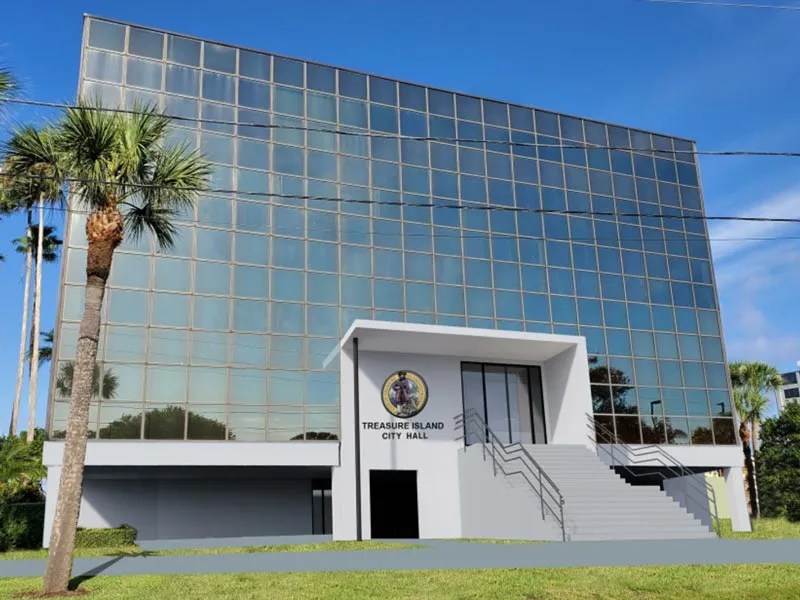
Treasure Island commissioners recently decided to delay two significant initiatives: the creation of a living shoreline at Treasure Bay and a policy requiring residents to indemnify the city before obtaining building permits if a substantial damage assessment hasn’t been conducted.
On Nov. 7, Commissioner Bob Minning made a surprising motion to remove a $3 million amended contract for the living shoreline project from the agenda. Living shorelines use natural elements, such as oyster reefs, mangroves, and marsh grasses, as environmentally friendly alternatives to traditional seawalls.
“I think we need more time to take a closer look and evaluate the numbers, the contract, and the potential implications,” Minning stated. Vice Mayor Arden Dickey and Commissioner Deborah Toth agreed, with Toth adding, “I haven’t had a chance to review the contract either.”
City Manager Chuck Anderson offered to provide a briefing on the project, but Minning requested a more comprehensive review, covering aspects like funding, the bidding process, and potential outcomes if the city decides not to proceed.
Mayor John Doctor warned that stopping the project could jeopardize $1.87 million in grant funds from the state and the Tampa Bay Estuary Program, awarded in 2020. “I’m not sure a ‘do nothing’ option is the best route,” Doctor said.
Toth suggested also considering the cost of a traditional seawall replacement as an alternative to the living shoreline. In a report, Assistant City Manager Stacy emphasized that the project was initially intended to address issues with the deteriorating Treasure Bay seawall and to transform Treasure Bay into a model waterfront recreation facility. The living shoreline project also aimed to address two stormwater ponds that drain into Boca Ciega Bay.
Resident Frustrations Over Permitting Policy
Meanwhile, the city is also reconsidering its approach to issuing building permits. Previously, the city had denied permits unless substantial damage assessments were completed by the county and FEMA, which led to resident complaints. Last week, FEMA informed the city that it could, in fact, issue permits before homeowners received the assessments.
Despite this, many residents voiced frustration at a Nov. 7 meeting, after being told they would have to sign an affidavit indemnifying the city and accepting legal responsibility if any issues arose. The affidavit required residents to assume legal and financial responsibility if challenges were raised later.
The Citizens’ Voice of Treasure Island, a local advocacy group, joined residents in opposing the measure, citing obstacles in obtaining permits for even minor repairs like drywall and electrical work, and inconsistent guidance from city staff.
Commissioner Minning asked for clarification on the affidavit’s necessity. City Attorney Jennifer Cowan explained in an email that a FEMA affidavit has long been required with permits, both before and after recent hurricanes. The new affidavit was introduced to highlight additional risks for residents proceeding with work before damage assessments are completed.
Cowan cautioned that, should FEMA determine substantial damage assessments lack adequate data to verify repair costs, the agency could take enforcement action against the city.
Dickey expressed his intent to keep residents informed of potential risks before they invest in repairs without full inspection reports. “I was thinking of a simple disclaimer,” he said, explaining the goal was to avoid unnecessary expenses for residents while waiting on inspections, not to complicate the process.
In response, Minning advocated for removing the affidavit requirement as quickly as possible. City Manager Anderson confirFmed that the building department will now issue permits for residents without substantial damage assessments, eliminating the need to sign an indemnity affidavit.
Follow us on Facebook, Instagram, Threads, Google, & X
(Image credit: Treasure Island-Madeira Beach Chamber)


 St. Pete-Clearwater Sun
Leave a comment