
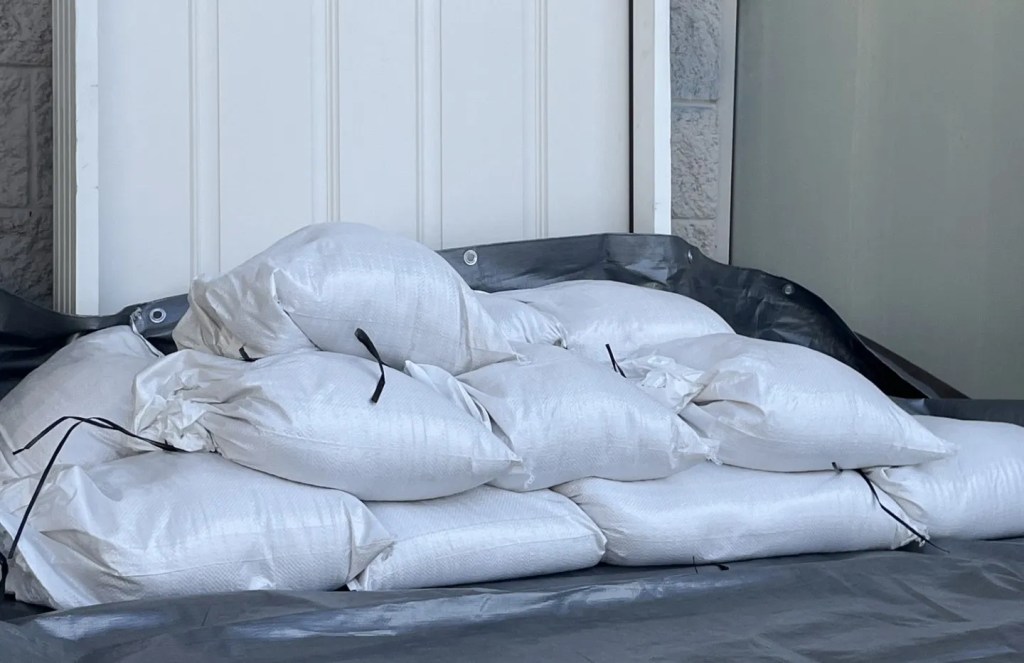
With Tropical Storm Milton spinning and soon forming into Hurricane Milton in the Gulf of Mexico and on a path to the west coast of Florida, residents of the Sunshine State, still reeling from Hurricane Helene, must prepare for another powerful tropical weather event and many projected to be potential victims will board up windows, secure loose outdoor items, and stack sandbags around their homes. Some will surround their entire properties, while others will place sandbags in front of doors, including front, back, side, and garages. (photo credit WFLA)
But, do such precautions actually protect Pinellas County properties from water penetration and do they really stop houses from being flooded when a hurricane strikes, or are sandbags only effective in certain, less serious situations like small storms?
Well, these are good questions because there’s much more to know about sandbags and to understand what they are and how sandbags work, particularly if people rely on them for emergency protection. So, when it comes to a tropical storm or hurricane and the storm surge and flooding these dangerous weather circumstances bring, do sandbags really deliver what people think they will do or are sandbags less effective than homeowners hope?
What Sandbags Are Made of and What They’re Mostly Used For
Sandbags, crafted from burlap or woven polypropylene, are typically packed with sand or soil. The sand inside traps fine particles like silt and clay from floodwaters, filling in the gaps and enhancing their effectiveness as barriers. As water passes through, the sand becomes muddier, reducing the amount of water that can seep through. Although primarily known for flood protection, sandbags are also frequently used for:
- Military fortification
- Erosion control
- Traffic control
- Commercial and residential construction
Believe it or not, sandbags are also used in the health and medical industries, chiefly in hospitals, clinics, and medical schools for compression, patient positioning, x-rays, coagulation, and other case-uses.
Biggest Misconceptions about Sandbags
Sandbags can reduce water intrusion but are not a foolproof barrier. They are effective for low-flow protection, up to two feet. It’s advisable to use a water barrier, like a tarp or trash bag, over your door before placing sandbags. Here are some more common myths about sandbags people believe:
- Sandbags are reusable. Sandbags are not meant to be reused and should be discarded or dispersed into a garden after contact with water. If left in the sun for a long time, they can also biodegrade.
- Sandbags are cheap. In reality, sandbags can be costly and labor-intensive. A linear meter of sandbagging can exceed $250, and covering a 15-yard entrance could surpass $4,000. (This is why Pinellas County supplies them for free until supplies last.)
- Sandbags are an effective flood defense. Sandbags are not always reliable as water can seep through the bags, and finer materials can leak out through the seams.
Additionally, while sandbags are sustainable because they do not contribute to the accumulation of microplastics in the ocean, they do contribute to the expansion of landfills – particularly after emergencies when storms have passed by and the bags have already been used before.
What Not to Do with Sandbags
When prepping for a hurricane with sandbags, avoid overfilling them. And, do not rely on sandbags solely for storm surge defense. Avoid leaving them outside for long periods before the storm, and don’t substitute garbage bags for sandbags—garbage bags simply aren’t sturdy enough. Also, always check local guidelines for proper sandbag use and placement.
The Right Way to Use Sandbags
Sandbags should only be filled about 3/4 of the way and used in conjunction with a tarp or heavy plastic, such as polyethylene plastic sheeting. Place the tarp down first and then stack the sandbags over the tarp or heavy plastic. Stagger the sandbags and don’t place them in a straight line. Be sure to pack the bags tightly together and push them into place. Do not space them out.
Key points to remember:
- Filling. Avoid overfilling sandbags; keep them half to two-thirds full to ensure proper stacking and avoid bursting.
- Placement. You can arrange sandbags lengthwise in the direction of water flow, with the open end facing the water source. Or, stack them as described above, packing bags tightly together.
- Door and window protection. Place sandbags directly against the bottom of doors and windows, stacking as necessary to create a more impenetrable seal.
- Plastic sheeting. Use a plastic sheet or tarp behind the sandbags to further prevent water seepage through cracks.
- Stacking technique. Ensure each layer is fully compacted before adding the next one, and stagger the bags slightly to prevent gaps.
As always, check with your local emergency management for specific sandbag usage instructions based on your area’s flood risks.
Situations When Sandbags Are Most Effective
Sandbags work best in water-related emergencies. For example, they serve as an effective barrier during flash floods. They can also combat minor flooding, with sandless sandbags being deployable in a sink or bathtub for quick action. But, there are reasons you don’t see sandbags being recommended for severe weather events, including strong tropical storms and hurricanes. And that’s because sandbags are typically inadequate.
Situations When Sandbags Are Least Effective
People often panic when they know a big storm is coming. Unsurprisingly, homeowners and business owners alike attempt to prepare as best as possible. And, since sandbags are generally available for free in Pinellas County or can be filled by residents, they seem like an ideal defense mechanism. However, sandbags are most useful against flash floods or minor flooding. But sandbags prove least effective in the following scenarios:
- High-flow protection. They work best for low-flow situations, up to two feet. For high-flow protection, a more permanent solution is needed.
- High winds sandbags. These offer insufficient protection when high winds are the primary threat.
- Placed too early. If sandbags are deployed too early, they may not be effective when needed.
- Contaminated by floodwaters. Sandbags exposed to floodwaters might be contaminated with hazardous substances like chemicals, sewage, septic waste, animal waste, oil, gasoline residue, and lawn chemicals. Consult your local environmental health department for safe disposal methods.
And here’s one situation that should be obvious – an already flooded property. If your property is already flooded, sandbags won’t be useful. Focus on protecting yourself and your belongings instead.
Well, there you have it – you now know the most common misconceptions about sandbags, their right and wrong uses, and their primary purposes. Sure, you can use sandbags in just about any tropical storm or hurricane but your expectations ought to be realistic since sandbags don’t deliver guaranteed protection from water penetration. However, sandbags can help reduce or mitigate flooding.



 St. Pete-Clearwater Sun
Leave a comment